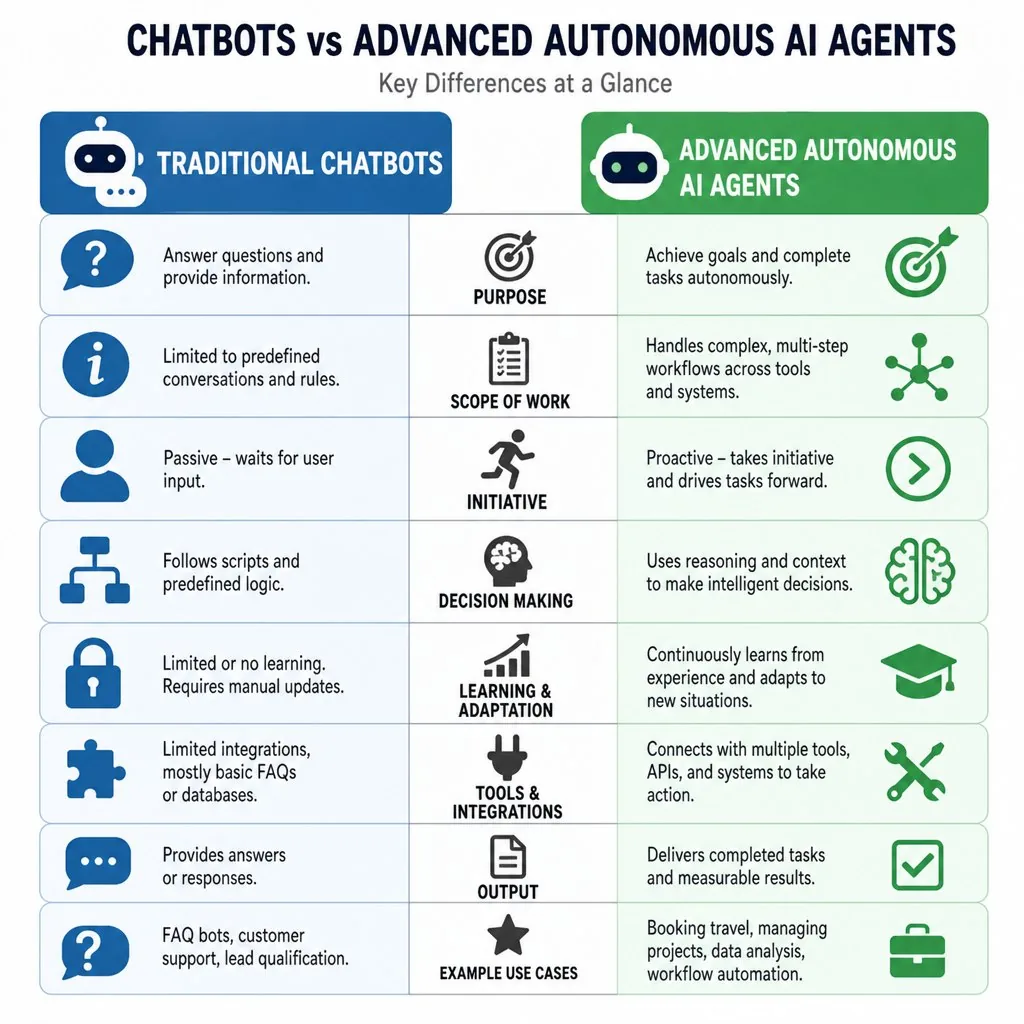
For two years, enterprise AI meant copilots: assistants that drafted, summarized, and suggested while a human did the doing. That era isn't over — but it's no longer the frontier. The frontier is agents: software workers that plan, act, and escalate. Understanding the difference is the difference between buying a feature and hiring a workforce.

Copilots assist; agents act
A copilot drafts the case reply; a human reads, edits, sends. An agent resolves the case: queries the order system, applies the policy, writes the reply, updates the record — and hands the human only the cases that need judgment. The unit of value changes from “minutes saved per task” to “tasks that no longer arrive.” That's why agentic programs get measured in deflection rates and cost per interaction, not adoption surveys.
What made agents possible
Three things converged. Reasoning engines that can plan multi-step work — Salesforce's Atlas engine runs a plan → evaluate → refine loop rather than single-shot generation. Grounding infrastructure — Data 360's unified profiles and vector retrieval, so agents answer from your data instead of the model's imagination. And governance machinery — the Trust Layer's masking, zero-retention model handling, and audit trails, plus permissioned actions so an agent can only touch what its user context allows.
The line that actually matters: bounded autonomy
The copilot-to-agent shift isn't about removing humans; it's about moving them. In a well-designed agent program, humans stop doing volume and start doing judgment — exceptions, escalations, empathy. The engineering discipline that makes this safe is bounded autonomy: topics that define what the agent may discuss, deterministic paths for regulated steps, explicit action permissions, adversarial testing before launch, and health monitoring after. Autonomy without bounds is a liability; bounds without autonomy is just a chatbot with better marketing.
How to make the transition without regret
- Keep your copilots. Assistive AI still earns its keep in drafting and summarization. Agents extend it; they don't replace it.
- Start where volume is boring. The best first agent handles high-volume, low-judgment work with clean data underneath — order status, password resets, appointment booking.
- Fix the data the agent touches. Not all data — the agent's data. Scope readiness to the use case, ship in 90 days, widen from evidence.
- Measure like a workforce. Resolution rate, escalation quality, cost per interaction — the same way you'd evaluate a new hire's first quarter.
What changes for the org chart
Treating agents as a workforce has practical HR-shaped consequences. Someone provisions them (which permission sets, which topics), someone reviews their work (escalation sampling, transcript audits), and someone owns their performance (a named human accountable for deflection and accuracy numbers). Organizations that skip this treat the agent as “the vendor's problem” — and discover at the first incident that governance can't be outsourced. Our deployments name an agent owner before go-live, full stop.
The metrics that matter by month
Month one: containment rate and escalation quality — is the agent resolving, and are its handoffs useful? Month two: accuracy sampling against source data, cost per interaction versus baseline. Month three onward: drift — new products, changed policies, and shifting volume erode grounding quietly; a monthly knowledge-freshness review is the cheapest insurance in AI. This cadence is built into our 90-day pilot precisely so the habit exists before scale does.
The full picture — platform, use cases, governance, pricing, and our 90-day pilot — lives in the Agentforce pillar. For where your organization actually stands on the readiness curve, the KAIROS™ model is the honest mirror.