Industries · Higher Education
Salesforce for higher education, from admissions to advancement
Salesforce solutions for higher education start from a hard truth — universities run the hardest data model in CRM: every student is an applicant, an enrollee, an alum, and sometimes an employee — simultaneously, under FERPA. We architect Education Cloud and EDA orgs that hold up, integrate the SIS honestly, and add campus agents designed FERPA-first. Current delivery: the University of British Columbia.
The seven campus agent patterns
The PlaybookThe agent patterns we design for universities — each with guardrails, escalation, and FERPA-conscious permissions. Horus presents; the details are below, with links.
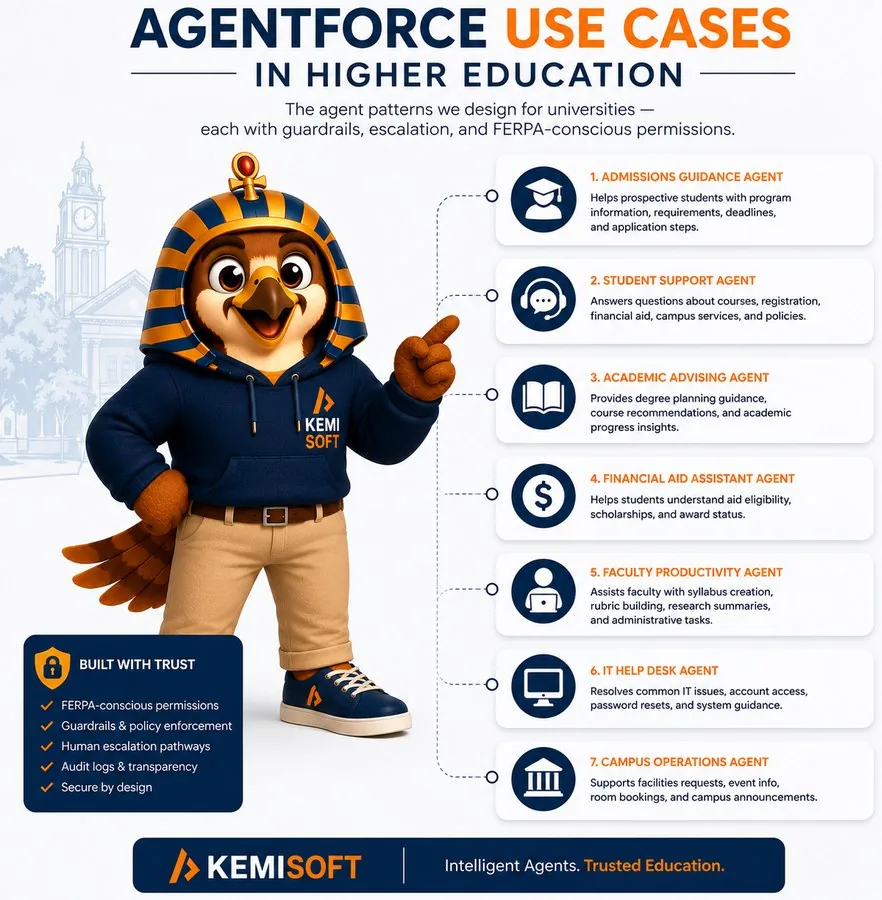
Admissions guidance agent
Helps prospective students with program information, requirements, deadlines, and application steps — 24/7, in the hours applicants actually ask.
Student support agent
Answers questions about courses, registration, financial aid basics, campus services, and policies — grounded in your knowledge base, escalating with context.
Academic advising agent
Degree-planning guidance, course recommendations, and academic-progress insights that prepare advisors before every appointment.
Financial aid assistant
The most deadline-driven inbox on campus: aid eligibility, scholarship, and award-status questions answered instantly; sensitive cases routed to aid officers.
Faculty productivity agent
Syllabus assembly, rubric building, research summaries, and the administrative tasks that eat teaching time.
IT help desk agent
Common IT issues, account access, and password resets resolved in Slack or the portal — the highest-adoption first agent on most campuses.
Campus operations agent
Facilities requests, event information, room bookings, and campus announcements — with documents generated through DocGen where paperwork follows.
Built with trust, on every pattern above: role-based permissions and least-privilege access · deterministic paths for regulated steps · Trust Layer masking and audit logs · human escalation always available · adversarial testing before launch — the guardrail discipline of our transformation loop.
The platform underneath: Education Cloud, EDA, and the SIS
Agents stand on the org, and higher-ed orgs stand on three decisions: the account model (chosen deliberately, not by default), the SIS integration (Banner, Colleague, Workday — synced with error handling someone actually watches, via our integration practice), and access architecture a FERPA auditor can follow. The education assessment track scores all three, plus the EDA-to-Education-Cloud question answered with your usage data instead of conference anxiety.
Why Kemisoft for higher ed
We scope Salesforce solutions for higher education end to end — recruiting funnels, student success, advancement — with the same architecture-first discipline as every practice here.
Education/Sales Cloud architecture in delivery at the University of British Columbia; Towson University and GIA on the client wall; recruiting-to-advancement patterns from the same bench that runs our Agentforce and document automation practices — transcripts, verifications, and acknowledgment letters included.
What Horus Eye looks for in higher education Salesforce orgs
Evidence firstTen admission cycles of configuration meet a migration decision. Horus Eye turns archaeology into evidence:
- EDA coupling — the custom dependency count that sizes an Education Cloud move
- Admissions process health: the automation stack on application objects, in order
- Student identity across recruit → applicant → enrolled records
- Reviewer and advisor access: who can actually reach applicant data
- Experience Cloud exposure for applicant and student portals
- Agentforce readiness for admissions and advising agents — FERPA-conscious by construction
Frequently asked questions
FAQDoes Kemisoft work with Education Cloud or EDA?
Both — current Education/Sales Cloud architecture work at the University of British Columbia, plus EDA orgs maintained and assessed, with an evidence-based read on the EDA-to-Education-Cloud question.
How do campus AI agents handle FERPA?
Agents inherit Salesforce's permission model, so FERPA-conscious access is designed first: least-privilege data scopes per agent, deterministic paths for sensitive topics, audit logs on every conversation, and human escalation always available.
Bring the campus playbook to your campus
A strategy conversation or an education-track assessment — architect-led either way.
Try Horus Eye Book an AI Strategy Workshop