Our Approach
Why clients say we feel different
Most consultancies sell capacity. We sell conviction: an architect-led way of working, written down, measured, and public — so you can hold us to it before you've spent a dollar. And since 2026 the method is instrumented: Horus Eye reads your org before we do, clears the safe debt with you, hands our architects the evidence to build on, and keeps watching after go-live. This page is the whole operating system: the manifesto we believe, and the See→Decide→Transform→Operate→Evolve loop that turns both into delivery.
The manifesto: what we believe
Conviction
Written so you can hold us to it — and so the wrong clients can rule us out early. Both save everyone time.
1. Architecture before automation
AI initiatives don't fail for lack of AI — they fail for lack of architecture. Ungrounded data, ungoverned permissions, disconnected point solutions. We fix foundations first, even when it delays the demo. Especially when it delays the demo.
2. The architect who scopes it, delivers it
No partner-sells, juniors-deliver bait-and-switch. The PhD-led architect in your first workshop is accountable for your go-live. Our reviews name our consultants personally because clients actually know them.
3. Teach before we sell
Our method, checklists, and calculators are public. If you take the loop and deliver without us, that's a win for the ecosystem — and the clients who do call us come knowing exactly how we think.
4. Honest claims only
We don't promise what the platform can't do or pretend experience we don't have. Every client name on this site is a real engagement; every number is measured or attributed. It costs us some flash. It buys us second projects — which is where our reviews come from.
5. Products keep us honest
We ship our own AppExchange products — KemiCard and Redlining Manager. Living with our own architecture decisions in production, under security review, keeps our consulting advice grounded in consequence.
6. The measure is the second year
Anyone can go live. The question is whether the org is trusted, adopted, and cheaper to change twelve months later. We design — and price — for the second year.
Know where you actually stand
Evidence, not aspirationEvery AI conversation should start with an honest answer to one question: how ready are we, really? Horus Eye measures it directly — data trust, access scope, automation currency, platform debt — as evidence-backed findings in your own org, each with a fix path. No maturity theater; a baseline you can re-measure.
Your level determines everything downstream: which use cases are credible, what the pilot should prove, and what must be fixed before agents touch customers. We score it in the AI Strategy Workshop and re-score it annually — the delta is your transformation, in one number.
How the work actually runs
The loop
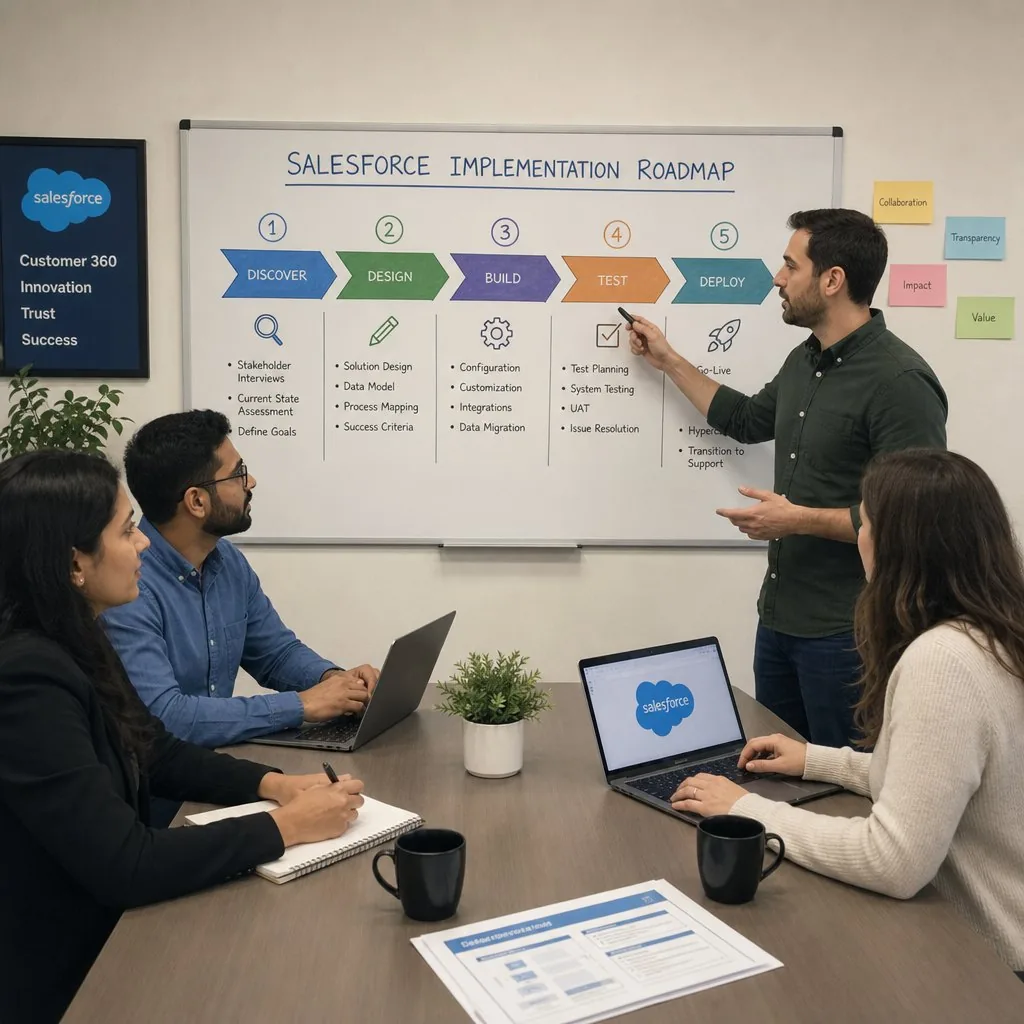
Five phases, each with an evidence gate. The point of the gates isn't ceremony — it's that momentum is the most expensive force in consulting, and gates are how you refuse to be carried by it.
- See. Horus Eye establishes the evidence baseline — read-only, before the first workshop — then stakeholder interviews rank use cases by evidence — expected volume, data readiness, and dollar impact, not enthusiasm. Gate: a business case you'd defend to your CFO.
- Decide. Data grounding, permission model, integration patterns, and guardrail design — decided before build, documented as decisions with reasons. Gate: an architecture your security team signs.
- Transform. Fixed-scope delivery — with Horus Eye clearing the safe debt reversibly alongside: deterministic paths for regulated steps, adversarial testing before launch, UAT packages our clients call the best they've received. Gate: it survives hostile testing, not just the demo script.
- Operate. Launch is a beginning: agents and humans working together. Training, communication, and the feedback loop from real usage into fixes — because the workaround your team invents in week two is the real requirements document. Gate: usage data, not launch emails.
- Evolve. Horus Eye re-scans and measures the delta: health, regressions, new debt, the next move — a standing backlog seasoned by production evidence. Gate: the second-year test — trusted, adopted, cheaper to change.
One loop, one instrument
We used to describe this as two frameworks — a delivery method and a readiness model. Horus Eye made both simpler: the loop above is the method, and the evidence baseline is the readiness model. Every phase has an instrument reading attached, and the loop repeats because the re-scan always finds the next move.
The Value Pyramid: where we aim
Every engagement targets a rung: efficiency (hours returned) → experience (customers and employees who notice) → growth (revenue the platform helped win) → reinvention (things the organization simply couldn't do before). We name the rung in the statement of work, and we measure against it — that's what “measured in business outcomes” means in practice.
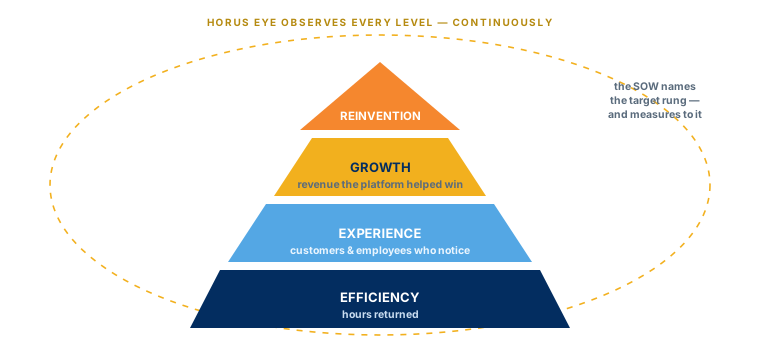
And around the whole pyramid: Horus Eye observes every level continuously — intelligence is not the foundation layer, it is the monitoring layer.
Where to go from here
Agentforce & AI agents
The digital-workforce pillar: what agents do, how they're governed, and how we deliver them.
Salesforce consulting
Every cloud, one accountable partner — the full platform practice, since 2017.
Health Assessment
The evidence-first way to start: find out where your org stands before deciding anything.
Frequently asked questions
FAQWhat is Kemisoft's delivery method?
One continuous loop — See, Decide, Transform, Operate, Evolve — led by the architect who delivers it, with evidence gates between phases instead of momentum-driven scope. Horus Eye instruments the loop: it establishes the evidence baseline before work starts and re-scans after go-live to measure the delta.
How does Kemisoft measure AI readiness?
With evidence, not a maturity ladder: Horus Eye measures the technical conditions an AI workforce depends on — data trust, access scope, automation currency, platform debt — as findings in your own org, each with a fix path.
How is Kemisoft different from other Salesforce SIs?
Three structural differences: the architect who scopes your work delivers it (no bait-and-switch staffing); we teach before we sell (frameworks, calculators, and guides are public); and we productize what we learn (KemiCard and Redlining Manager are shipping AppExchange products, not slideware).

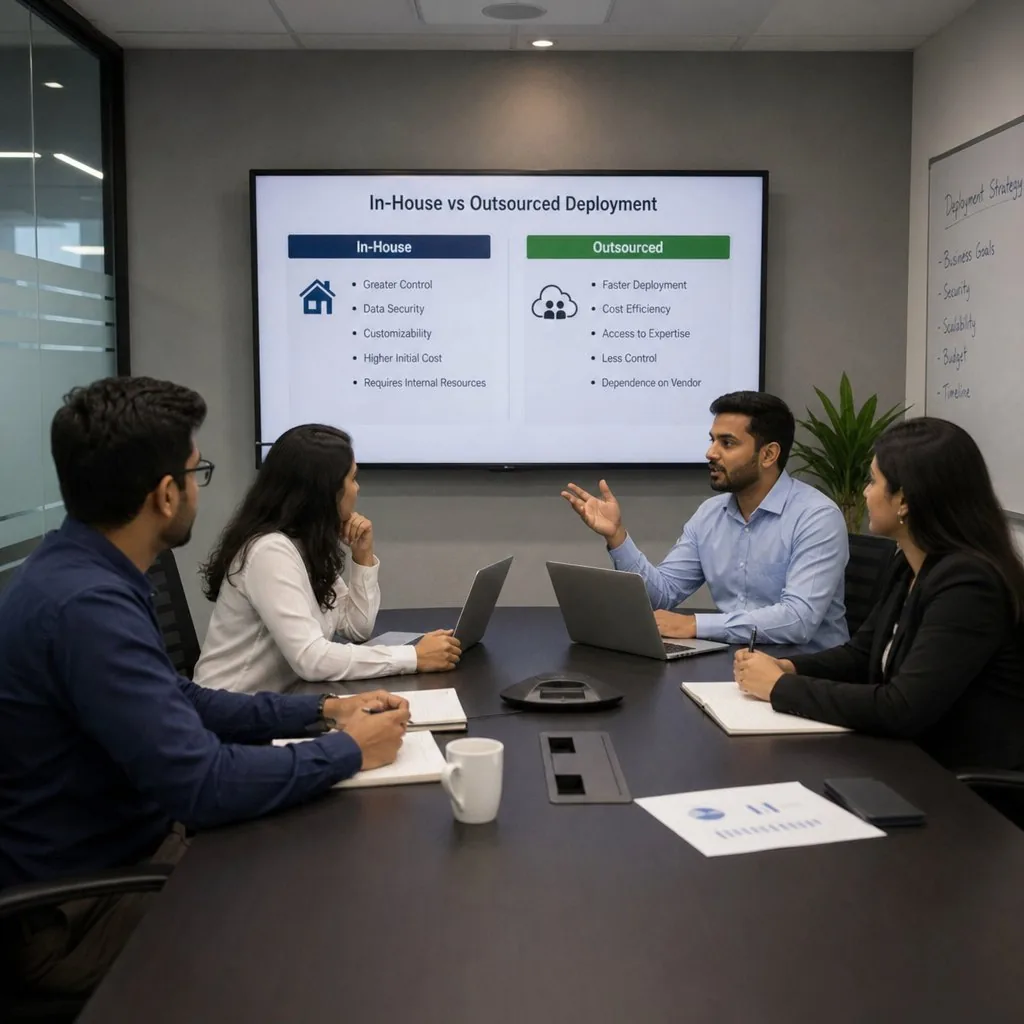

Written down, so you can hold us to it
Horus wears the cape on this page only — conviction deserves a costume. Everything above is how we actually operate; the fastest way to test that claim is one workshop.
Horus™ is the Kemisoft falcon — named for the sky-eyed guardian of ancient Kemet.
Work with people who wrote it down
One workshop. Your Horus Eye evidence baseline, a ranked opportunity map, and an architect you can hold to all of the above.
Try Horus Eye Book an AI Strategy Workshop