Managed Services · Support
Salesforce managed services without the junior tier
Most Salesforce support services hand you a ticket queue and a rotating cast; most application support stops at break-fix. Salesforce support here means the same certified, senior consultants who deliver our projects — on transparent buckets of hours, against a backlog you control. The clients who buy a second bucket before the first runs out are the reason this practice exists.
What the hours cover
ScopeAdministration & support
Users, permissions, flows, reports, and the daily asks — handled by people who understand why the org is built the way it is.
Optimization & enhancements
The standing backlog: improvements sequenced by value, technical debt retired deliberately, releases adopted instead of survived.
DocGen & agent care
Nintex template changes and upgrades, plus agent health monitoring — resolution rates, escalation quality, drift — as support scope, not an afterthought.

How the model works
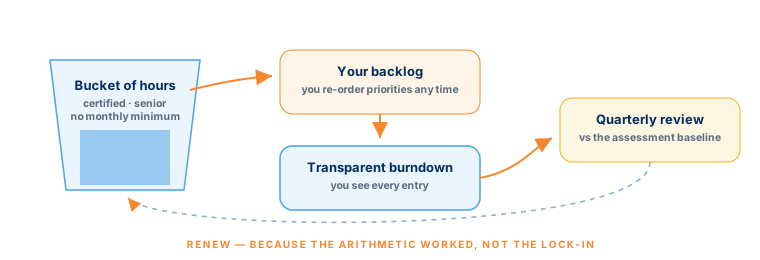
Buckets of hours, burned down transparently — you see every entry. No minimum monthly spend, priorities re-ordered whenever yours change, and a quarterly review against the assessment baseline so support is measurably improving the org, not just keeping the lights on. It's the second-year principle as a service: trusted, adopted, cheaper to change.
Engagement models, compared honestly
How to Buy| Model | Best for | The honest trade-off |
|---|---|---|
| Bucket of hours | Variable demand; teams that want senior help on tap without monthly minimums | You manage the priority queue — which most clients prefer, but it is a job |
| Standing cadence | Orgs with a steady enhancement backlog and release rhythm | A predictable burn in exchange for reserved senior capacity |
| Project + care | Fresh implementations — the delivery team stays on part-time through the second year | Costs more than cold handoff; pays for itself the first time something breaks at quarter-end |
Whichever model, the mechanics are identical: every hour logged against a named backlog item, visible to you; priorities re-ordered whenever yours change; and a quarterly review against your assessment baseline so support measurably improves the org.
How a support relationship starts
The First 30 Days- Baseline. A compressed health check — security posture, automation inventory, release state — so we support the org that exists, not the one the documentation describes.
- Runbook. Access, escalation paths, environments, and the who-approves-what map, written down before the first ticket.
- Backlog triage. Your existing wish-list scored by value and effort — quick wins surface immediately, and the first bucket usually pays for itself here.
- Rhythm. A working cadence that matches your team — weekly for active orgs, on-demand for stable ones — plus release-readiness reviews three times a year.
Why senior-led support changes the economics
Junior-tier support is cheaper per hour and more expensive per outcome: tickets bounce, context evaporates between rotations, and the org slowly accretes fixes that fight each other. Senior-led support inverts it — the person answering has usually seen the exact failure before, fixes it in the architecture rather than around it, and leaves the org simpler than they found it. That's why our support clients renew: not loyalty, arithmetic. It's also why support and project delivery share one bench here — the person who built the pattern answers for it.
Frequently asked questions
FAQHow do Kemisoft's Salesforce managed services work?
Buckets of certified hours burned down transparently against a standing backlog: administration, enhancements, integrations, document automation, and release readiness — with the same senior consultants who deliver our projects, not a separate support tier.
Can managed services cover Nintex DocGen and our agents too?
Yes — template changes, package upgrades, and DocGen support are a specialty, and agent health monitoring (resolution rates, escalation quality, drift) is part of modern support scope.
What if we just need occasional help?
That's what the bucket model is for: hours that roll, no minimum monthly burn, priorities you re-order any time. Clients keep renewing buckets — that pattern is quoted in our public reviews.


Always-on, like a good agent
Managed services is Horus's natural state: watchful, responsive, never off shift. Buckets of certified hours, burned down transparently.
Horus™ is the Kemisoft falcon — named for the sky-eyed guardian of ancient Kemet.
Support that makes the org better
A bucket of senior hours and a backlog you control — starting whenever you are ready.
Try Horus Eye Start the Conversation