Salesforce Field Service · FSL
A Salesforce Field Service consulting partner who's ridden the truck
Field service is where Salesforce meets the physical world — and where configuration mistakes cost real fuel, real overtime, and real customers. We implement, rescue, and extend Salesforce Field Service (the platform you may know as Field Service Lightning) with the discipline of a 12-month program behind us and the scars to prove it.
Field Service implementation, done right the first time
ImplementationTerritory & resource design
Territories sized to practice thresholds, skills modeled honestly, and coverage that survives vacations — the structural decisions everything else inherits.
Work types with real durations
Durations trued against actuals, not guessed at go-live — because one fictional duration cascades through every schedule, every day.
Mobile technicians adopt
Layouts designed with technician input, offline reliability tested in the field, and status flows that beat calling it in. Adoption is the metric; everything else follows.
Scheduling and dispatch that dispatchers trust
The EngineIndustry research says almost half of field appointments don't go as planned — and most causes live in configuration: scheduling policies never tuned to your objectives (SLA versus overtime versus travel), inconsistent travel buffers, and an optimizer whose early bad results taught dispatchers to override everything. We tune the Salesforce Field Service optimization engine until the schedule it builds is the schedule your team runs — then add Agentforce Field Service on top: schedule-gap filling, pre-work briefs, and plain-language dispatch actions.
Service contracts & entitlements
The Commercial LayerField work runs on promises: SLAs, maintenance plans, warranties, entitlements. We model service contract management so the promise made in sales is the promise scheduled in the field — and so renewals are driven by delivery data, not spreadsheets. The document side (work orders, service reports, contract paperwork) runs through our Nintex DocGen practice, generated at job completion, not typed at 5 pm.
Asset service management
The Install BaseAssets with real history — installs, repairs, parts, readings — are what make first-time fix rates move and what ground every pre-work brief an agent will ever generate. We build the asset model, the maintenance plans on top of it, and the reporting that turns install-base data into service revenue.
Why Kemisoft for Field Service
A 12-month Field Service and document-automation program for an energy enterprise sits behind this practice — the client whose VP of Business Systems called our UAT packages the best they'd received, and bought more hours to make us their development partner. Salesforce Field Service consultants, certified across Sales and Service Cloud, delivering with our transformation loop. When you're ready for the agent layer, the Agentforce pillar covers exactly what it adds.
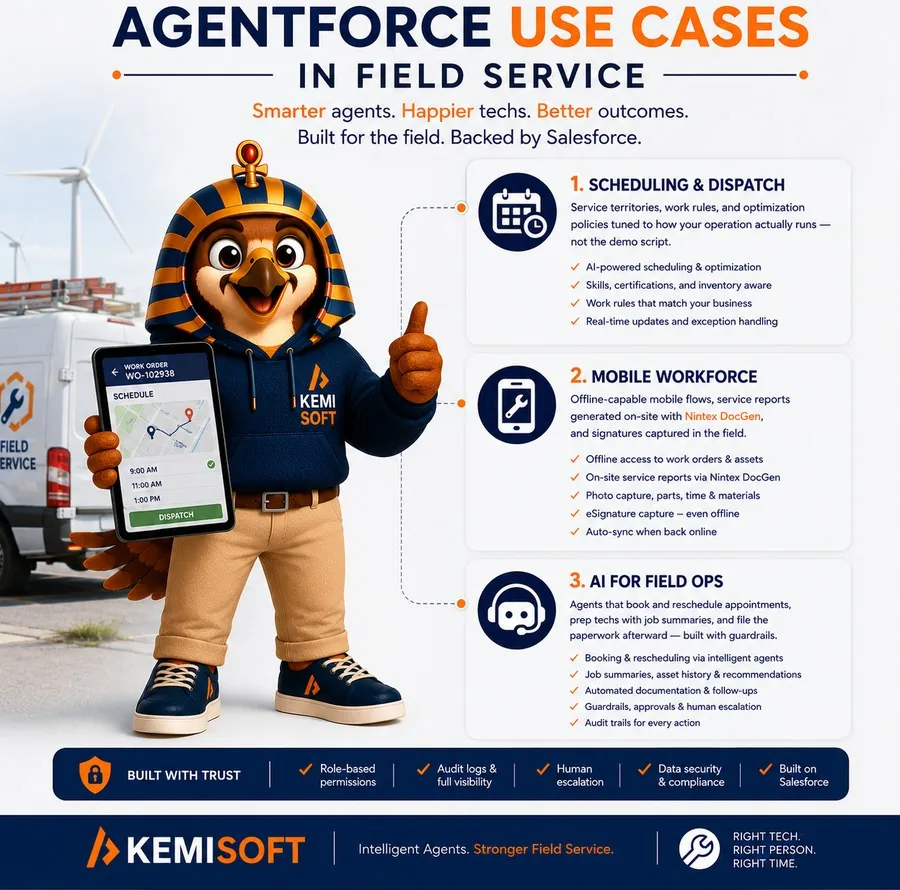
The four numbers that run a field operation
MeasurementFirst-time fix rate
The compound metric — it moves only when asset history, parts data, briefs, and skills modeling all work. That's why it's our north star for every engagement.
Schedule adherence
The gap between the plan at 7 am and reality at 5 pm. Persistent gaps mean fictional durations or untuned policies — both findable, both fixable.
Technician utilization
Wrench time versus windshield-and-admin time. Travel modeling moves the first half; post-work summary agents attack the second.
Time to schedule
Request to confirmed appointment. Where customer experience is won — and where agent-driven gap filling shows up first.
Every Field Service engagement here starts by baselining these four and ends by re-measuring them. That's the measured-in-business-outcomes principle applied to trucks.
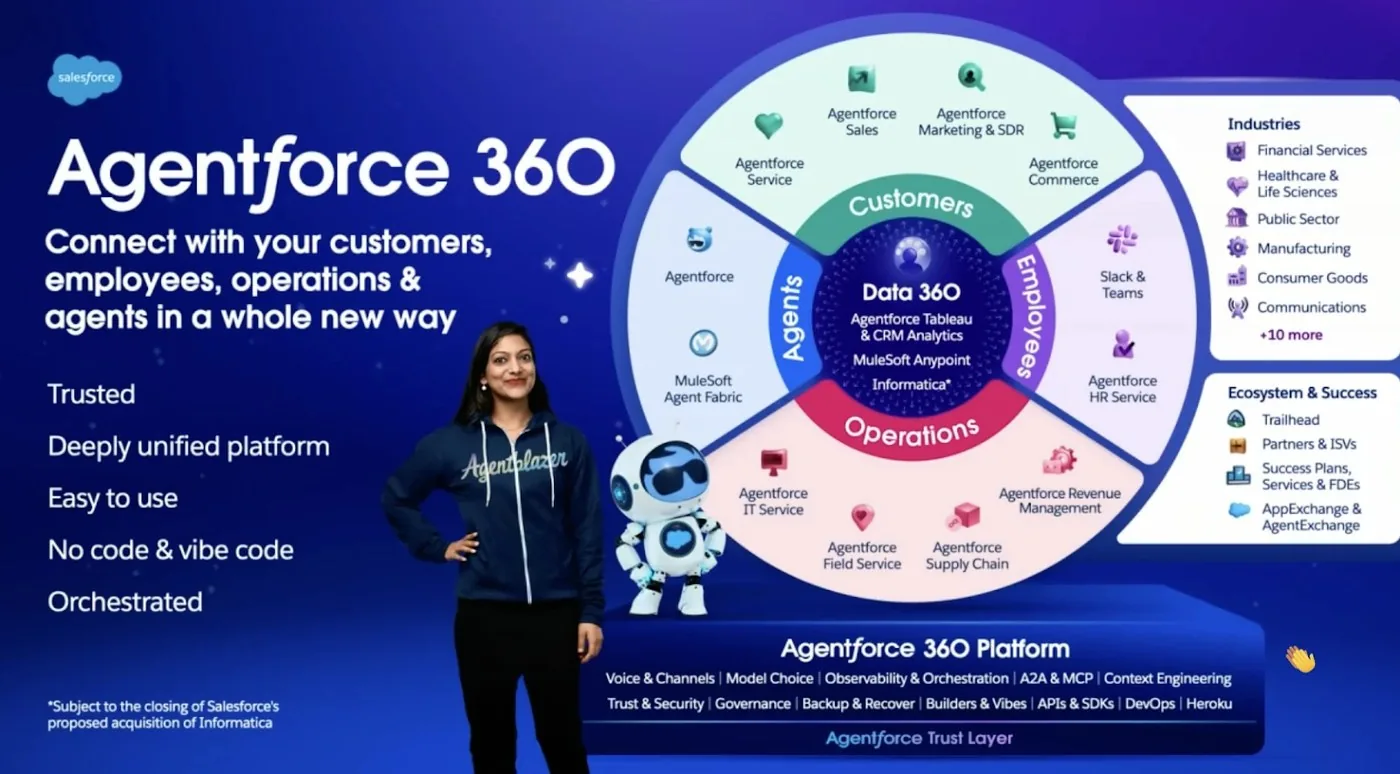
A rollout order that survives contact with reality
Playbook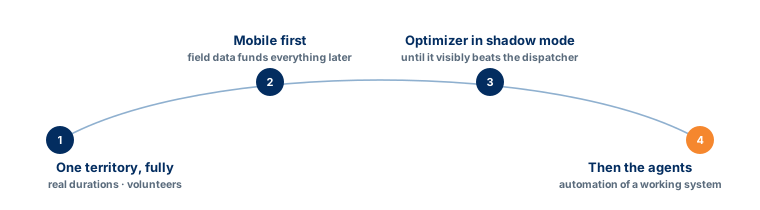
- One territory, fully. Prove the model where you can watch it: real durations, tuned policies, technicians who volunteered.
- Mobile before optimization. Get the app into hands early — field data quality funds everything later, and technician trust is easier built than rebuilt.
- Optimizer with training wheels. Run engine schedules in shadow mode until dispatchers see it beat them; trust follows evidence, not mandates.
- Then the agents. Gap-filling and briefs land on a foundation that deserves them — automation of a working system, not a hopeful one.
Field service runs on configuration nobody has read end-to-end
What Horus Eye looks for hereBefore mobile redesigns and AI booking, Horus Eye reads the operational layer:
- Work-order automation in execution order — and where it overlaps
- Service territory and scheduling configuration complexity
- Asset and service data trust: duplicates and identity on the objects dispatch depends on
- Integration reliability into ERP and inventory — the edges a missed callout breaks
- Mobile page complexity technicians actually face
- Agentforce readiness for scheduling and status agents
Frequently asked questions
FAQDoes Kemisoft implement Salesforce Field Service (formerly Field Service Lightning)?
Yes — full Field Service implementations: territories, work types, scheduling policies, dispatch console, and the mobile app technicians actually adopt, plus rescue and optimization of existing FSL orgs. Reference program: a 12-month energy-sector delivery whose UAT packages the client called the best they'd received.
Can you fix a Field Service org another partner implemented?
That's roughly half the practice. We start with the Field Service assessment track — territories, durations, travel buffers, optimizer trust — and sequence fixes by impact.
What does Agentforce add to Field Service?
Agents that fill schedule gaps from cancellations, generate pre-work briefs technicians hear en route, give dispatchers plain-language control, and write post-work summaries — all on the optimization engine you already run.

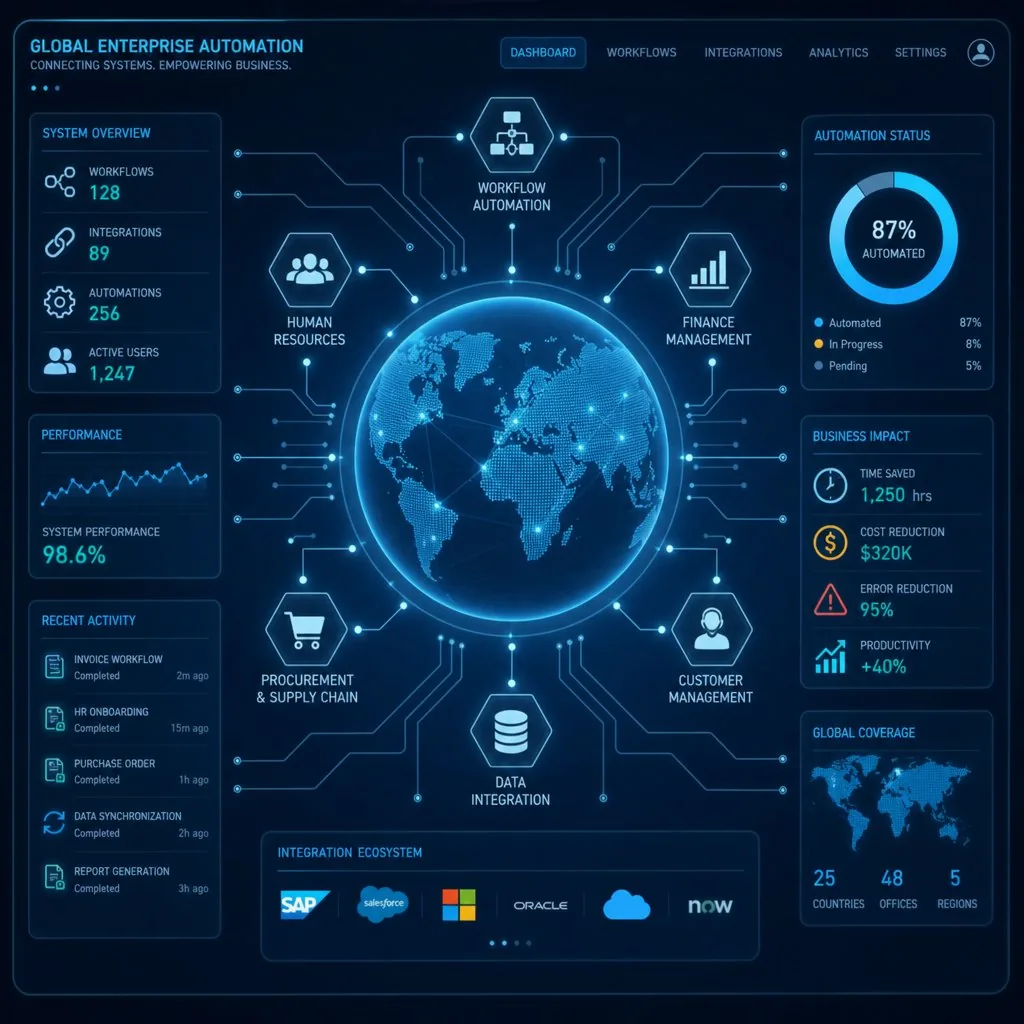


Dressed for the truck roll
Vest on, wrench ready — Horus takes field work seriously, and so do we: a 12-month Field Service program whose UAT packages the client called the best they'd received.
Horus™ is the Kemisoft falcon — named for the sky-eyed guardian of ancient Kemet.
Every truck roll, fully briefed
Start with the Field Service assessment track or scope the implementation directly — either way, you talk to the architect.
Try Horus Eye Talk to the Architect