Implementation · Salesforce Consulting & ISV Select Partner
A Salesforce implementation partner that shows its work
Most Salesforce implementation horror stories share a root cause: nobody could see the org. Decisions ran on status decks, discovery ran on interviews, and the truth surfaced at UAT. Kemisoft implements differently — Horus Eye baselines the org before we start, senior architects deliver in phases that each ship working capability, and the same instrument verifies what changed. Evidence in, evidence out.
Why implementations fail — and what prevents it
The Honest ListThe industry's failure patterns are well documented and boringly consistent: requirements gathered from the loudest voice instead of the process, data migrated dirty because cleansing "would delay go-live," customization stacked on customization until nobody owns the design, and adoption treated as a training problem when it was a design problem. None of these are technology failures. A CRM implementation is a business change program wearing a software badge — and every one of those patterns is visible early if you have an instrument watching the org instead of a status report describing it.
What we implement
ScopeSales Cloud
Pipeline, forecasting, and territory design that match how deals actually move — not the org chart.
Service Cloud
Routing, knowledge, SLAs, and deflection — assessed against the queue's reality, not the demo's.
Revenue Cloud
Quote-to-cash on the platform Salesforce is actually investing in — including CPQ migrations.
Field Service
Territories, scheduling, dispatch, and mobile — with a 12-month enterprise program behind the practice.
Agentforce
AI agents on a foundation measured ready for them — readiness assessed as findings, not vibes.
Integrations
ERP, SAP, and the middleware layer — the part of every implementation that decides whether data can be trusted.
How an evidence-led implementation runs
The Method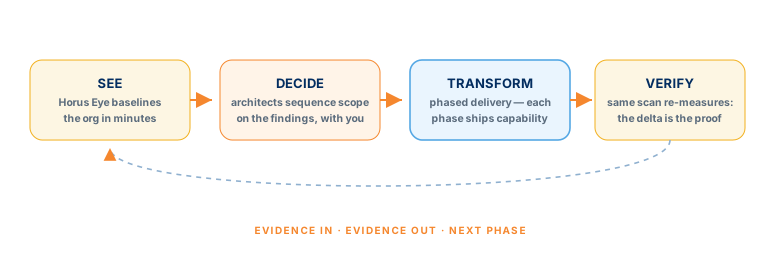
- See. Horus Eye scans the estate — existing org, or the org another partner left behind. Findings with evidence replace discovery folklore.
- Decide. Architects sequence scope against the findings: what to build, what to fix first, what to consciously defer. You see the same evidence we do.
- Transform. Phased delivery, each phase shipping capability someone uses — with data cleansing and adoption design inside the phases, not appended after them.
- Verify. The same scan that baselined the org re-measures it. The delta is the deliverable: what changed, proven by the instrument, not asserted by the vendor.
That loop is why our implementations don't produce the classic post-go-live mystery org. It's also what distinguishes Salesforce implementation partners who measure from those who describe — the question worth asking anyone bidding for your program. (Choosing for an Agentforce program specifically? We wrote down what to ask.)
Implementation is a beginning, not a handoff
Go-live is the midpoint of the transformation loop, not the end. Orgs drift the moment people start using them — which is why every Kemisoft implementation can roll into managed services with the same architects and the same instrument watching, and why the baseline we hand you is re-measurable forever. The partner conversation shouldn't end at the go-live party; the org certainly doesn't.
Frequently asked questions
FAQHow do I choose a Salesforce implementation partner?
Ask three things: who actually staffs the work (architects or a rotating junior bench), how they measure the org before and after (opinion or instrument), and what happens after go-live (handoff or managed services). Salesforce implementation partners who can't answer all three concretely are describing hopes, not a method.
How long does a Salesforce implementation take?
A focused single-cloud implementation typically runs a few months; multi-cloud programs run longer, in phases that each ship working capability. What compresses the timeline most is starting from evidence — a Horus Eye baseline replaces weeks of discovery workshops with a scan that takes minutes.
Can you take over or rescue a failing Salesforce implementation?
Yes — rescue work is a substantial share of the practice. The takeover starts with a scan of what the previous team actually built (not what the status decks claimed), a findings review with you, and a re-sequenced plan. The evidence makes the awkward conversation short.
What makes a CRM implementation succeed?
Treating it as a business change program, not a software install: process decisions made before configuration, data quality addressed before migration, adoption designed rather than hoped for, and a measurable definition of done. The technology is the easy third.
Start from evidence, not estimates
One scan of your org — or your half-finished implementation — and the scoping conversation runs on findings instead of folklore.
Try Horus Eye Scope an Implementation