Horus Eye · Data Health
Can leaders trust the numbers coming out of Salesforce?
When two dashboards disagree, the meeting stops being about the business and starts being about the data. Data trust is an architecture property — identity, controls, lineage — and it degrades quietly. Find the data problems your dashboards, and soon your agents, will inherit: here is what Horus Eye can prove today, what it deliberately does not claim, and how the gap gets fixed.
What Horus Eye measures here — honestly, a narrow slice
Coverage honestyTwo shipped rules feed the Data Health dimension, and this page will not inflate them. Core object with no duplicate rules (high): Account, Contact or Lead carrying no duplicate rules means nothing in the org’s own metadata stops duplicates at entry — and the rule says plainly what it cannot see: a rule that exists but is switched off, or prevention living in an MDM outside the org. Duplicate record groups (low): records sharing a matched-field value that may be duplicates — a count from an aggregate query, because Horus Eye never stores record data.
When both fire together, the gap and its consequence sit side by side in the queue: no rules on Lead, and the duplicate Lead groups that let in. Around the rules, Deep Read adds evidence — field population, duplicate and matching rule reads, and report lineage that shows which numbers rest on which fields.
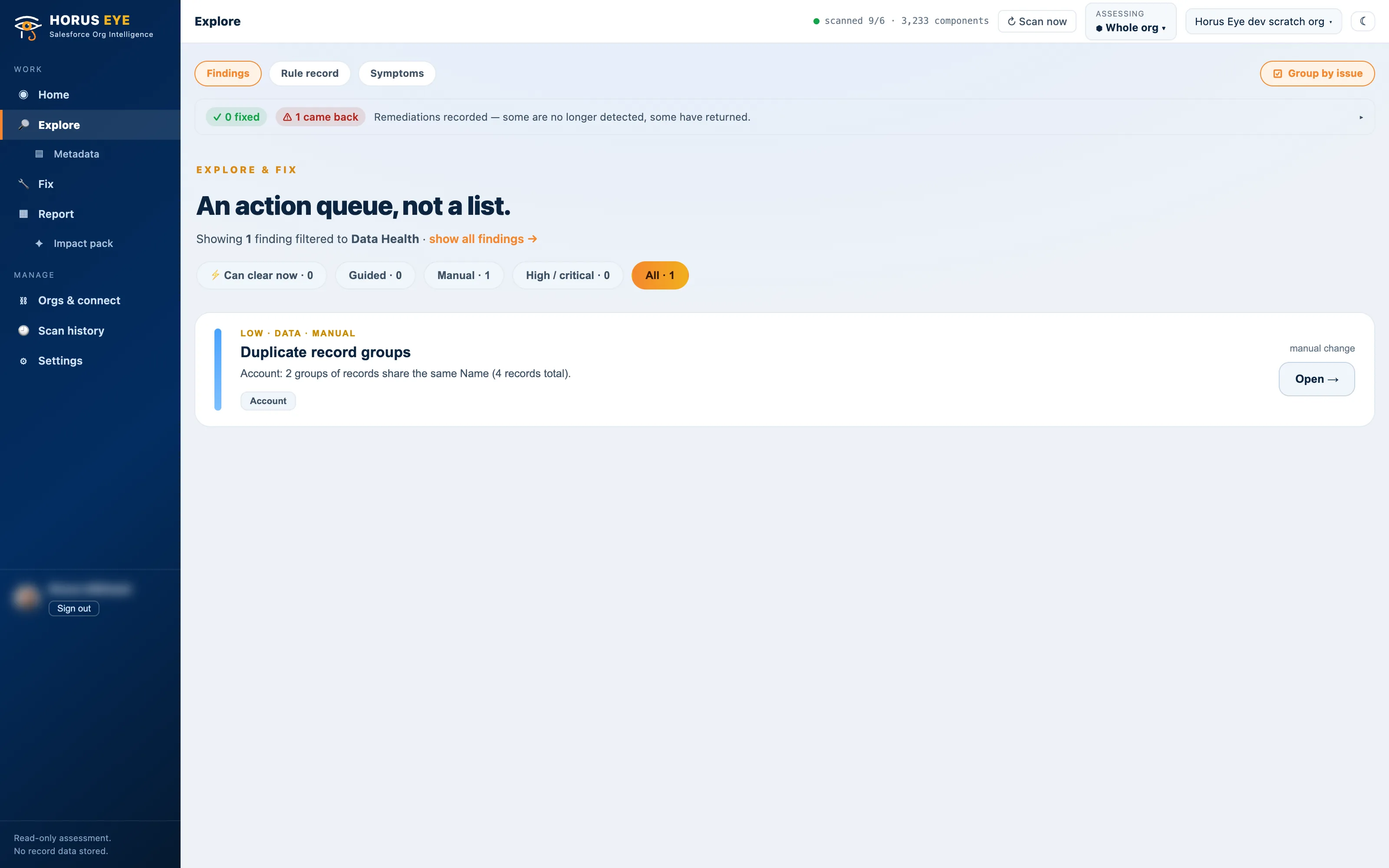
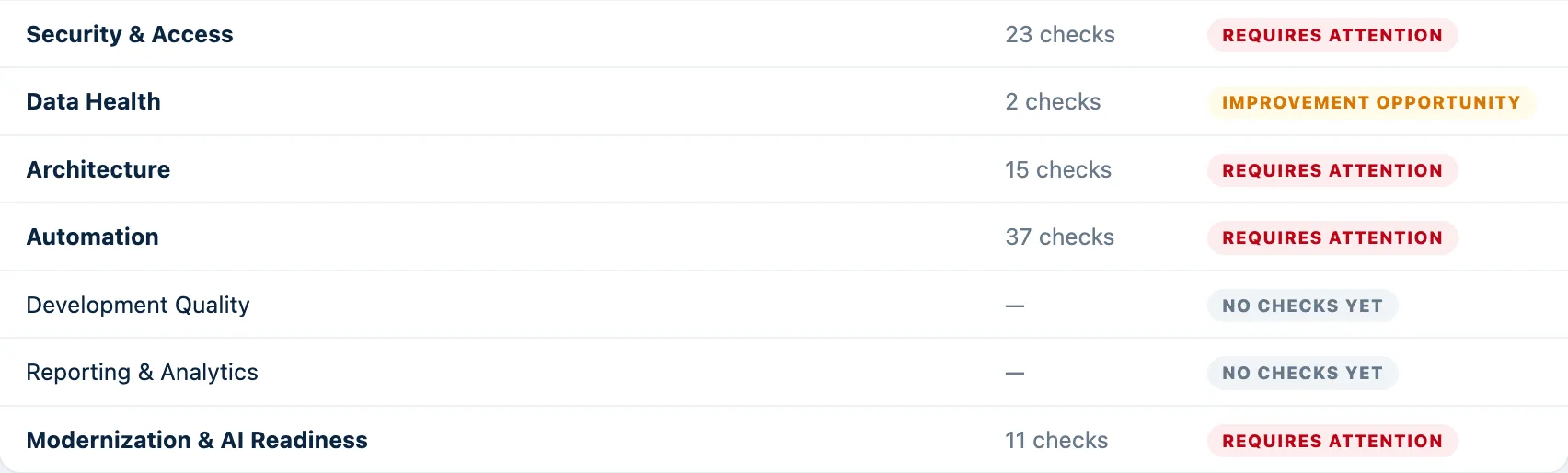
There is no “Data Trust Score” in Horus Eye today, and none is quoted here. A score computed from a handful of rules would be the strongest possible good-news claim from an absence of evidence — the product refuses that, and so does this page.
This evidence is also where honest Salesforce data cleansing starts. Most CRM data quality programs fail by cleansing alphabetically — every record, every field, no priority. The duplicate groups and report-lineage evidence invert that: a data cleansing effort scoped to the fields your executive dashboards actually rest on is smaller, cheaper, and visibly done. Horus Eye isn’t a salesforce data cleansing tool itself — it never touches record data — it is the targeting instrument that tells the cleansing where to aim.
Why complete-looking data still isn’t trusted
The pattern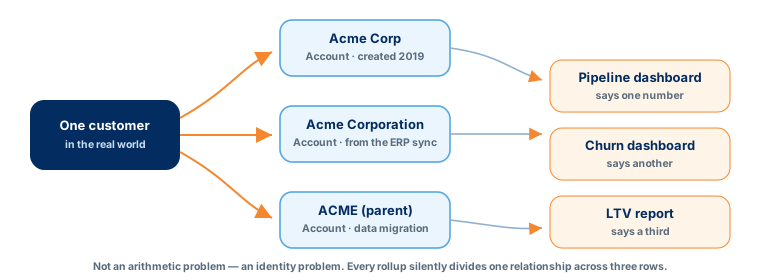
High field completeness, low decision trust
- What Horus Eye detected
- Customer records appear highly complete — required fields populated, validation passing — yet identity fragmentation (the same customer under three Accounts) and conflicting sources for the same attribute reduce the trustworthiness of every rollup built on them.
- Evidence
- Duplicate record groups on Account and Contact; no duplicate rules on the affected objects; report lineage showing executive dashboards resting on the fragmented fields.
- Why it matters
- Every report that groups by customer silently divides one relationship across several rows. Pipeline, churn and lifetime-value numbers disagree between dashboards — not because the math differs, but because the identity does.
- Recommendation
- Stand up duplicate and matching rules on the core objects first (Salesforce ships standard ones); merge the existing groups with the owning teams; then re-scan — the missing-rules finding clears, and the group counts become a trend to watch.
- Confidence
- Illustrative pattern — explicitly not a measured score
This is the data-quality problem worth an executive’s attention: not empty fields, but fragmented identity. It is also why “how does data quality affect Agentforce” has a sharp answer — an AI agent grounded on fragmented identity confidently gives three answers to one question. Data readiness comes before agent readiness; the readiness page makes that concrete. The same logic governs migrations: in an NPSP to Agentforce Nonprofit move, every record gets transformed, so every identity problem becomes a transformation problem — cleaning first is cheaper than cleaning mid-flight.
The clearing here is guided — and whose it is
Honest splitHorus’s plan names the unguarded objects and the standard rules to activate; the merges and the identity decisions belong to owners who know the customers. That work — matching strategy, survivorship rules, the MDM conversation — is Kemisoft’s data practice, working from Horus Eye’s evidence rather than a blank whiteboard.
Frequently asked questions
Straight answersHow do I audit Salesforce data quality?
Start with controls, not content: which core objects lack duplicate rules, which have duplicate groups, which fields feed executive reports. Content-level profiling comes after — and needs record access Horus Eye deliberately doesn’t take.
How do duplicate rules work?
A matching rule defines what counts as “the same”; a duplicate rule decides what happens at entry — warn or block. Salesforce ships standard ones for Account, Contact and Lead; activating them is usually the first fix.
Why do dashboards disagree?
Usually identity, not arithmetic: the same entity split across records, or two reports resting on different fields for the same concept. Report lineage makes the second visible; duplicate groups the first.
How does data quality affect Agentforce?
An agent answers from the data it is grounded on. Fragmented identity means confidently inconsistent answers — the worst failure mode, because it looks like the agent works.
Protected AI — the Trust Layer
Every AI read in Horus Eye is metadata-first: built from an allowlist, sanitized by pattern, made through one audited gateway and checked by an output firewall on the way back — and AI is off by default, per org. Every request carries an audit id and an AI Data Scope manifest you can open.
Know what the numbers rest on
A read-only scan shows the control gaps and duplicate groups on your core objects — the first honest step toward dashboards that agree.
Try Horus Eye Analyze Your Salesforce Org All Horus Eye pages