Horus Eye · For Nonprofits on NPSP
NPSP Migration Readiness Assessment
Salesforce calls the move from NPSP to Agentforce Nonprofit (formerly Nonprofit Cloud) a reimplementation — and reimplementations are priced by what your org actually contains, not by what the brochure assumes. Before you plan, budget, or sign anything: get the evidence. We analyze your real org with Horus Eye, then an architect turns the findings into a migration decision you can defend to your board.
Why readiness is measurable — not a questionnaire
Evidence Over EstimatesMost “readiness assessments” in this market are a survey and a score. But two NPSP orgs with identical licenses can differ by an order of magnitude in migration effort — and the difference lives in the metadata: custom fields on NPSP objects, Apex and Flows that reference the package, integrations that read and write donation records, reports built on NPSP rollups, and the data debt accumulated over a decade of campaigns. None of that is visible to a questionnaire. All of it is visible to a scanner.
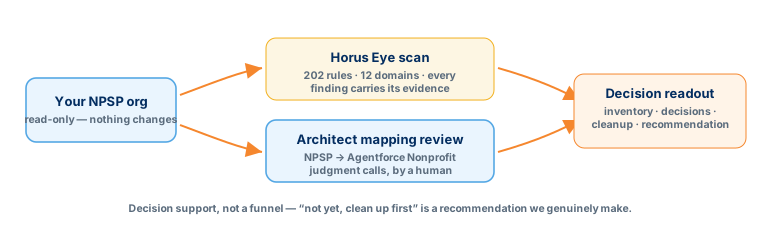
Horus Eye analyzes your org read-only across 202 rules in 12 domains — architecture, automation, data, security, development and more — and every finding carries its evidence: the component, the dependency, the reason it matters. That analysis becomes the factual floor of your migration conversation.
What the assessment examines
Your Org, Not a TemplateCustomization & coupling inventory
Which custom objects, fields, record types and components extend the NPSP data model — and which Apex, Flows, formulas, validation rules and Lightning components reference NPSP objects. This is the inventory Salesforce’s own migration guide says to build before choosing a strategy, and it is where migration quotes are won or lost.
Automation & integration dependencies
The flows and triggers wired to Contacts, Opportunities, Recurring Donations and Households — and the external systems (payment processors, marketing tools, volunteer platforms) whose compatibility with the new architecture has to be verified, not assumed. Horus Eye’s dependency analysis shows what touches what, with evidence.
Data debt that becomes migration debt
Duplicate constituents, orphaned relationships, inconsistent donation records, fields nobody has populated in years. In a migration, every record gets transformed — so every data problem becomes a transformation problem. We identify what to clean, what to archive, and what not to carry into the next decade.
Architect-led NPSP mapping review
The nonprofit-specific judgment calls — Contacts to Person Accounts, households worth keeping, the affiliation-collision question, which Opportunities become Gift Transactions versus Commitments — reviewed by a Salesforce architect against Salesforce’s June 2026 migration guide and your actual business processes. Tools inventory; architects decide.
Built on the audits Salesforce itself prescribes
The Guide’s Chapters 3 & 4Salesforce’s migration guide opens with two audits before any strategy is chosen. The business process audit (chapter 3) asks why each configuration exists — real organizational need, or an accommodation of NPSP? — across permissions and record access, integrations and packages, and objects, fields and record types. The technical audit (chapter 4) asks how each piece works and classifies every integration and automation as compatible as-is, adaptable with modification, or requiring full redesign.
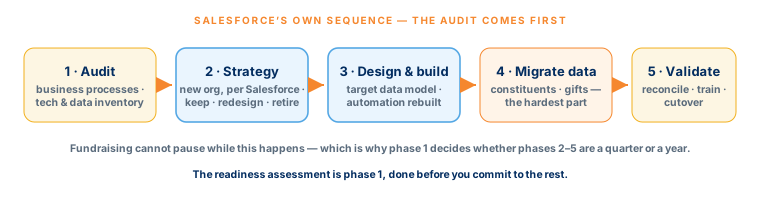
That is precisely the split our assessment automates and staffs: Horus Eye produces the how — the dependency inventory, the NPSP coupling, the automation and integration surface, with evidence — at scan speed instead of weeks of workshops, and the architect supplies the why, the classification calls, and the guide’s license-compatibility and change-management considerations. You get the audit chapters Salesforce says to do, done with instruments instead of interviews alone.
What you walk away with
The ReadoutA readout your leadership can act on: the full customization and dependency inventory; the NPSP-coupled components that need mapping decisions (and which decisions they are); the data issues worth fixing before any migration — cleanup that pays off even if you stay; and a clear recommendation with reasoning: migrate soon, prepare first, or wait deliberately. If the right answer is “not yet,” that is what the readout says. There is no announced NPSP end-of-life, and we don’t invent deadlines.
When you do move, the same evidence base de-risks the project: the inventory becomes the migration workplan, and the cleanup list becomes the pre-migration sprint. Our nonprofit practice — NAACP, AIPAC, FASNY, the Chicago Community Trust — has lived on both sides of that handoff.
Questions nonprofits ask us
FAQWhat is an NPSP migration readiness assessment?
A structured, evidence-backed analysis of your existing NPSP org — customization intensity, NPSP coupling, automation and integration dependencies, data debt — that tells you what a move to Agentforce Nonprofit would actually involve before you commit to a plan or budget.
Does it change anything in our org?
No. Horus Eye is read-only by default; it analyzes metadata and configuration without modifying your org, and every finding carries its evidence.
Will you push us to migrate?
No. This is decision support, not a funnel. “Stay on NPSP for now and clean up first” is a recommendation we genuinely make.
What do we receive?
The inventory, the mapping decisions, the pre-migration cleanup list, and an architect’s recommendation — migrate soon, prepare first, or wait deliberately — with the reasoning attached.
Protected AI — the Trust Layer
Every AI read in Horus Eye is metadata-first: built from an allowlist, sanitized by pattern, made through one audited gateway and checked by an output firewall on the way back — and AI is off by default, per org. Every request carries an audit id and an AI Data Scope manifest you can open.
Know before you plan
One readiness assessment now beats a mid-project surprise later. Read-only analysis of your real NPSP org, architect judgment on top.
Request a Readiness Assessment