Nonprofits · Migration Guide · Last reviewed October 2026
NPSP to Agentforce Nonprofit: a reimplementation, honestly planned
Salesforce’s own migration guide says the move from Nonprofit Success Pack to Agentforce Nonprofit — formerly Nonprofit Cloud — “more closely resembles a reimplementation than a traditional software upgrade.” That is the single most useful sentence in the whole conversation — because it changes what you should do first. This guide covers where things actually stand, what changes architecturally, and how to decide when (and whether) to move.
Where things stand — without the fear-mongering
Status, Dated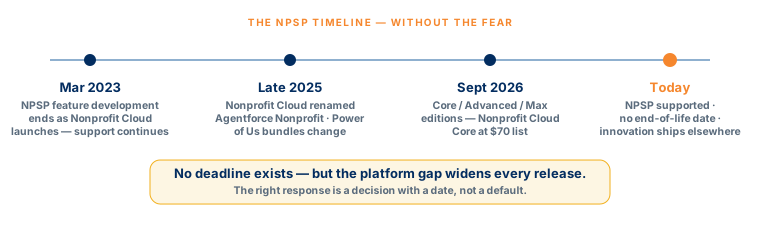
As of October 2026: NPSP is at what Salesforce calls End of Innovation — feature development ended in March 2023, when Nonprofit Cloud launched, per Salesforce Ben’s reporting — but it remains supported, and Salesforce’s Power of Us guidance states there is no requirement to migrate until your organization is ready. No end-of-life or end-of-sale date has been announced. Anyone selling you a migration against a deadline is selling you a deadline.
What has changed: Nonprofit Cloud was renamed Agentforce Nonprofit in late 2025 — so if you’ve been researching an “NPSP to Nonprofit Cloud migration,” this is the same move with a newer name; the Power of Us grant now offers new applicants ten free Agentforce Nonprofit licenses or ten Sales & Service Cloud licenses (NPSP, which is a set of managed packages rather than a license type, can still be installed on the latter — but preconfigured NPSP orgs are no longer offered); and on September 3, 2026, Salesforce retired the Enterprise, Unlimited and Agentforce 1 editions in favour of Core, Advanced and Max. Every new capability Salesforce ships for its nonprofit platform — including the AI agents — is built for Agentforce Nonprofit, not NPSP. The platform’s center of gravity has moved, even though your org keeps working.
The September 2026 editions, for nonprofits
The restructuring applies to NPSP orgs and Agentforce Nonprofit orgs alike, so your next renewal happens on these terms either way. US list prices per user/month, billed annually:
| Edition | Replaces | General list | Nonprofit Cloud list |
|---|---|---|---|
| Core | Enterprise — including the ten Power of Us (P10) seats | $195 | $70 |
| Advanced | Unlimited | $395 | $125 |
| Max | Agentforce 1 | $550 | $285 |
Each tier carries an annual Flex Credits allocation for consumption-based AI features (500,000 / 1,000,000 / 2,750,000 per org per year on the general editions). Figures from Salesforce’s September 3, 2026 announcement and nonprofit-vertical guidance; confirm current pricing with Salesforce or your account executive before budgeting. Prices last reviewed October 2026.
Why Salesforce says: new org, not in-place
The Guide’s Own WordsThe June 2026 migration guide is unusually direct: Salesforce strongly recommends implementing Agentforce Nonprofit in a new Salesforce org rather than transforming an existing NPSP org in place — “the negatives outweigh the positives.” The guide’s own reasoning, summarized: Person Account migration is mandatory — every Contact must become one, and doing that inside a data import to a fresh org is more practical than an in-place transformation; records split, not map — migrating NPSP Opportunities means splitting each record across multiple destination objects, which the guide calls complex and error-prone to attempt inside a live org; and the two products cannot actively coexist in one org — Agentforce Nonprofit could technically sit provisioned but deactivated during transformation, yet if its features are switched on prematurely, they cannot be reverted. Even afterwards, the guide warns that fully removing the NPSP package from an org is itself challenging and error-prone. A new org sidesteps all four traps.
A new org also forces the question most organizations need to answer anyway: which of the last decade’s customizations, fields, and automations deserve to exist in the next decade? A migration done well is a deliberate re-founding of your CRM — done badly, it is the same debt with new object names.
What actually changes — the ten transformations
Architecture, SummarizedFrom the migration guide’s account-model, campaign, gift and activity sections. The full data-model walkthrough is in our architecture deep dive.
People & households
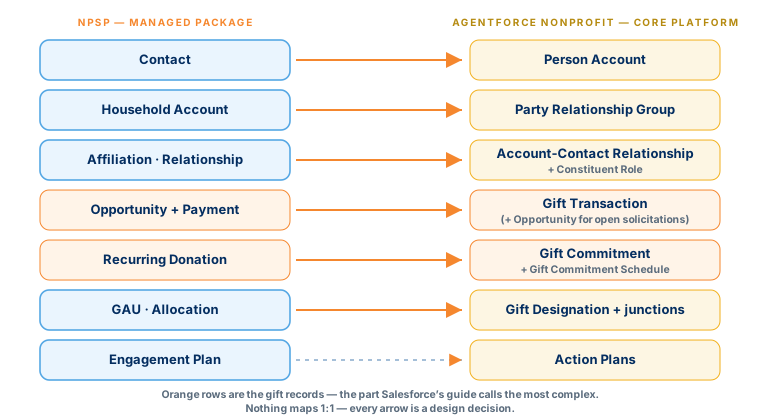
- Contact → Person Account — identity transformation, not a field rename
- Household Account → Party Relationship Group — and not every household should migrate at all
- NPSP Relationship → Contact-Contact Relationship — type and direction mapping
- NPSP Affiliation → Account-Contact Relationship / Constituent Role — historical multi-role affiliations collide with the one-ACR-per-pair model
- NPSP Address → Contact Point Address — history and seasonal preferences need a strategy
Money & engagement
- Opportunity / Payment → Gift Transaction (+ Opportunity for open solicitations) — financial records split by what they actually represent
- Recurring Donation → Gift Commitment + schedules — active donor arrangements must survive the move
- GAU / Allocation → Gift Designation + junctions — fund accounting continuity
- Campaign hierarchy → Campaigns + Outreach Source Codes — attribution restructuring
- Engagement Plans → Action Plans — a process redesign, not a data copy
Salesforce’s guide singles out gift migration as “one of the most complex and time consuming portions” of the whole move.
What you actually gain on the other side
From Salesforce’s Implementation GuidesThe honest case for migrating is the platform underneath. Salesforce’s own implementation guides for Nonprofit Cloud, Fundraising and Program Management describe a set of industry-platform services that NPSP never had — each worth knowing before you decide:
Fundraising intelligence, built in
Data Processing Engine (DPE) replaces NPSP’s rollup fields: donor data points like Last Gift Date, Highest Gift Amount and Best Gift Year are produced by DPE definitions, and a built-in RFM score (recency, frequency, monetary value) ranks your donor base — something NPSP orgs typically bolt on with third-party tools. Record Alerts surface missed gift commitments and expiring payment methods on the record itself, and the Gift Entry Grid handles high-volume batch gift entry natively.
Relationships you can see
The Actionable Relationship Center (ARC) renders constituents’ relationships — interpersonal, business and personal affiliations — as an interactive graph, which the implementation guide marks as required for Fundraising. For organizations whose major-gift work runs on who-knows-whom, this is the single most visible upgrade.
Decisioning without code
Business Rules Engine (BRE) brings expression sets and lookup tables for eligibility and qualification decisions — program intake rules, benefit eligibility — with a Decision Explainer that records why a rule produced its result. OmniStudio and Batch Management round out the automation stack that replaces much of what nonprofits hand-built in NPSP-era Process Builder and Flow.
Programs as first-class objects
Program Management moves from the legacy PMM package’s flat Service object to a structured stack: Benefit Types with units of measure, Benefits tied to specific Programs, Benefit Assignments as entitlement records, and Benefit Disbursements tracking actual delivery — the model funders’ outcome reporting keeps asking for.
Caveat from the same guides: most of these services require Permission Set License assignments and deliberate configuration — they are capabilities to implement, not switches to flip. That design work is part of any honest migration estimate.
The work before the work
Audit First — Salesforce Agrees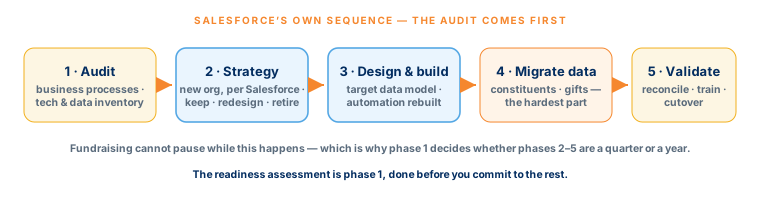
The guide’s own sequence starts with two distinct audits, and the distinction matters. The business process audit asks why each thing exists: which configurations support true organizational needs, and which were created only to accommodate NPSP — the goal being to identify what should carry forward and what can be simplified, redesigned, or retired rather than cataloguing everything. It covers user permissions and record access (the guide notes many platform licenses are incompatible with Agentforce Nonprofit, and role hierarchies often exist only to work around NPSP data structures); integrations, custom code and installed packages; and objects, fields and record types shaped by NPSP concepts.
The technical audit asks how it works and what it takes to make it work in the new environment: each integration and automation ends up classified as compatible as-is, adaptable with modification, or requiring full redesign — and third-party packages get checked for formal Agentforce Nonprofit support, not just vendor optimism. The guide then adds a change-management chapter for good reason: this is as much an organizational change as a technical one. In our experience the audits are where migrations are won or lost: two NPSP orgs with identical licenses can differ by an order of magnitude in migration effort, and the difference — customization intensity, integration coupling, data debt — is all measurable before anyone commits to a plan or a budget.
That is exactly the assessment our NPSP Migration Readiness Assessment produces: an evidence-backed inventory of what your org actually contains, what is coupled to NPSP, and what should be cleaned, kept, or retired — useful whichever way your migration decision goes. And deciding whether and when to move has its own logic: our decision framework walks through it without a sales agenda.

Why Kemisoft for this
The Nonprofit PracticeOur nonprofit practice runs deep: the NAACP program that won the 2022 Nintex Solution Innovation Award, AIPAC, FASNY, the Chicago Community Trust, YPO and more — plus the document automation and CLM work nonprofits depend on. We’re a Salesforce Consulting & ISV Select Partner, and we build our own products on the platform, so migration advice comes from people who live with the consequences of architecture decisions. Most importantly: we treat “don’t migrate yet” as a legitimate recommendation — the assessment is decision support, not a funnel.
Frequently asked questions
Straight Answers · October 2026Is NPSP going away?
No end-of-life has been announced. NPSP is at End of Innovation — no new features — but remains supported, and Salesforce’s Power of Us guidance says there is no requirement to migrate until you’re ready.
Is this an upgrade or a reimplementation?
Salesforce’s own guide calls it closer to a reimplementation: the account model, gifts, relationships, addresses and campaigns are all represented differently in Agentforce Nonprofit.
Can we transform our NPSP org in place?
Salesforce strongly recommends a new org — “the negatives outweigh the positives” — chiefly because of Person Accounts and NPSP package coexistence.
What’s the hardest part?
Gift migration, per the guide: Opportunities, Payments, Recurring Donations and Allocations map onto Gift Transactions, Commitments and Designations — and the right destination depends on what each record actually represents in your org.
Is this the same as an NPSP to Nonprofit Cloud migration?
Yes. Nonprofit Cloud was renamed Agentforce Nonprofit in late 2025, so an NPSP to Nonprofit Cloud migration and an NPSP to Agentforce Nonprofit migration are the same move — the core-platform, Person Account-based architecture that replaced the managed-package approach.
Can new nonprofits still get NPSP through Power of Us?
Partly. New applicants now choose ten free Agentforce Nonprofit licenses or ten Sales & Service Cloud licenses — and because NPSP is a set of managed packages rather than a license type, it can still be installed manually on the Sales & Service bundle. What’s gone is the preconfigured NPSP org. Existing NPSP organizations are unaffected.
How long does a migration take?
It depends on customization intensity, integrations, and data debt — which is why we assess before we estimate. Anyone quoting a duration before examining your org is guessing.
Sources & further reading
Check Our Work- Salesforce, Agentforce Nonprofit Migration Guide v2.0 (June 2026) — the primary source for the reimplementation framing, the new-org recommendation, the object transformations, and the audit-first sequence quoted throughout this page.
- Salesforce, Nonprofit Cloud, Fundraising and Program Management Implementation Guides — the source for the platform-services section above (ARC, BRE, DPE, RFM, Record Alerts, Gift Entry, the Benefit model). The corresponding developer references are public: the Fundraising developer guide and the Nonprofit Cloud developer documentation it belongs to.
- Salesforce for Nonprofits — the official Agentforce Nonprofit product page.
- Power of Us program and the official Power of Us application article — current license offerings for eligible nonprofits.
- Salesforce Ben, “The State of Salesforce Nonprofit Offerings in 2026” (Feb 2026) — independent reporting on NPSP’s support status, the March 2023 end of feature development, and the Power of Us license bundles.
- Kemisoft: the NPSP vs Agentforce Nonprofit data-model deep dive, the migrate-or-wait decision framework, and the NPSP Migration Readiness Assessment.
Decide with evidence, not anxiety
A readiness assessment of your actual NPSP org — customization intensity, NPSP coupling, data debt — before anyone talks timelines or budgets.
Try Horus Eye Book a Readiness Conversation