Every nonprofit running Salesforce is hearing some version of the same pitch right now: NPSP is legacy, Agentforce Nonprofit — formerly Nonprofit Cloud — is the future, migrate before it’s too late. Half of that is true. Here is the decision framework we actually use with clients — including the scenarios where our recommendation is don’t migrate yet.
Is there an NPSP end of life date? No — here are the facts (October 2026)
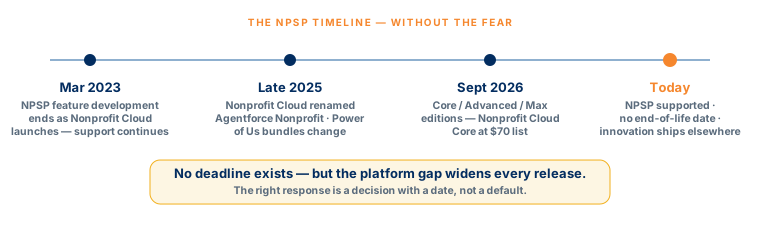
There is no NPSP end-of-life date. NPSP is at what Salesforce calls End of Innovation — it gets maintenance, security and compatibility updates, but no new features — and Salesforce’s own Power of Us guidance says there is no requirement to migrate until your organization is ready. Anyone pressuring you with a deadline is inventing one.
But three real forces are building. First: innovation has moved. Feature development on NPSP ended in March 2023, when Nonprofit Cloud launched, per Salesforce Ben’s reporting — every new nonprofit capability, from the fundraising objects to program management to the AI agents, ships on Agentforce Nonprofit. The gap between the two platforms widens every release. Second: the grant changed. New Power of Us applicants now choose ten free Agentforce Nonprofit licenses or ten Sales & Service Cloud licenses — NPSP (managed packages, not a license type) can still be installed on the latter, but the preconfigured NPSP org is gone, so new nonprofits increasingly start on the new platform and the ecosystem’s center of gravity follows them. Third: the economics changed. On September 3, 2026 Salesforce retired Enterprise, Unlimited and Agentforce 1 in favour of Core, Advanced and Max ($195 / $395 / $550 per user/month general list, each with an annual Flex Credits allocation for consumption-based AI), and the nonprofit tiers moved with them: Nonprofit Cloud Core at $70, Advanced at $125, Max at $285 per user/month list — with the ten free Power of Us seats mapping onto Core. The restructuring applies to NPSP orgs and Agentforce Nonprofit orgs alike, so your next renewal conversation happens on new terms either way. (List prices as of October 2026 — confirm with Salesforce before budgeting.)
The five questions that actually decide it
1. How customized is your NPSP org? A near-standard org with few custom fields and no custom code migrates far more cheaply than one with hundreds of fields on NPSP objects, custom Opportunity triggers, and household automation. Salesforce’s migration guide calls the move a reimplementation — and the reimplementation cost scales with customization intensity, not record count.
2. What is coupled to NPSP? Payment processors, marketing tools, wealth screening, volunteer platforms — each integration that reads or writes NPSP objects must be remapped and re-verified. Count them before pricing anything.
3. How much data debt are you carrying? Duplicate donors, orphaned relationships, inconsistent donation statuses, abandoned fields: migration transforms every record, so every data problem becomes a transformation problem. Cleaning first is cheaper than cleaning mid-flight.
4. What would you actually gain? Be specific here, because the gains are concrete. Per Salesforce’s own implementation guides, the new platform ships the Actionable Relationship Center (relationship graphs major-gift work runs on), native donor rollups and RFM scoring via the Data Processing Engine, Record Alerts for missed gift commitments and expiring payment methods, batch Gift Entry, a Business Rules Engine for eligibility decisioning, and a structured Program/Benefit model built for the outcome reporting funders keep asking for. If your fundraising model strains NPSP today — complex pledges, program-linked giving, AI ambitions — the architecture is built for exactly that. If NPSP comfortably runs your shop, the gain is mostly future-proofing, which is real but rarely urgent — and most of those services require deliberate configuration, not a switch.
5. Can your team absorb it? A migration is a project with discovery, design, testing, training and a cutover — through which fundraising cannot pause. Timing against your fiscal year, campaign calendar and audit cycle matters as much as readiness.
Three honest recommendations
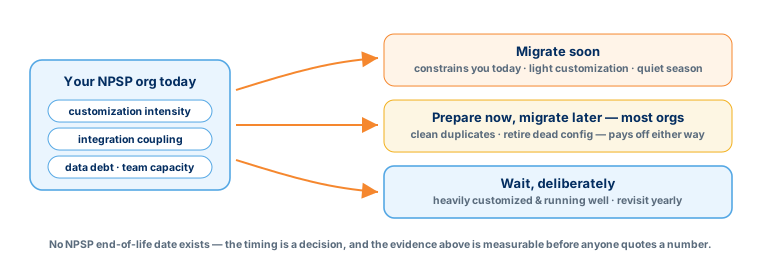
Migrate soon if NPSP actively constrains you, your customization is light-to-moderate, and you have budget and a quiet season. You get the platform where investment is flowing, with the smallest gap to jump.
Prepare now, migrate later — the right answer for most organizations. Inventory NPSP coupling, resolve duplicates, retire dead fields and automation, document what your customizations actually do. Every hour of cleanup pays off twice: your org runs better today, and the eventual migration shrinks.
Wait, deliberately if your org is heavily customized and running well, budget is tight, or a capital campaign is mid-flight. Waiting is a legitimate strategy when it’s a decision with a revisit date — not a default born of avoidance. Revisit annually: the platform gap, pricing, and migration tooling all keep moving.
Whatever you decide, do this first
All three paths start from the same place: knowing what your org actually contains. Customization intensity, NPSP coupling, integration surface, data debt — all measurable today, before anyone talks timelines or budgets. That evidence is what our NPSP Migration Readiness Assessment delivers, and it’s decision support, not a funnel: “stay on NPSP for now” is a recommendation we genuinely make. For what the migration itself involves, see the full migration guide and the data-model deep dive.