Salesforce is undeniably one of the most powerful Customer Relationship Management (CRM) platforms available on the market today. However, its true potential is only fully unlocked when it communicates seamlessly with the rest of your technology stack. If your CRM operates in a disconnected vacuum, you are missing out on vital business insights and operational efficiency. That is exactly why investing in the best salesforce integration services is no longer just a luxury—it is a strategic business necessity. Whether you are looking to streamline daily operations, empower your sales teams, or elevate the overall customer experience, bringing your disparate systems together under one unified umbrella makes all the difference. In this comprehensive guide, we will explore the top strategies, essential tools, crucial use cases, and expert tips to help you maximize your CRM capabilities.

Modern companies rely on a multitude of specialized software applications. You might utilize one platform for marketing automation, another for complex financial accounting, a separate system for inventory management, and yet another for customer support ticketing. Without robust technical alignment, these disjointed systems quickly create frustrating bottlenecks. By securely syncing third-party data with salesforce crm, you empower your internal teams with a single, reliable source of truth.
The real-time data synchronization benefits are immense and transformative. Sales representatives can view up-to-the-minute inventory levels while actively on a call, customer service agents can access comprehensive billing histories instantly to resolve disputes, and marketing executives can track the exact revenue return on investment of their campaigns. Ultimately, eliminating data silos with cloud middleware ensures that every department is aligned, drastically reducing manual data entry errors and speeding up response times. When your data flows freely and securely across all platforms, your business can pivot faster to meet customer demands.
Top Integration Middleware and Platforms
The enterprise software market is flooded with diverse salesforce integration tools specifically designed to bridge the gap between your CRM and external platforms. Choosing the correct tool depends heavily on your existing IT infrastructure, overall project budget, and specific business needs.
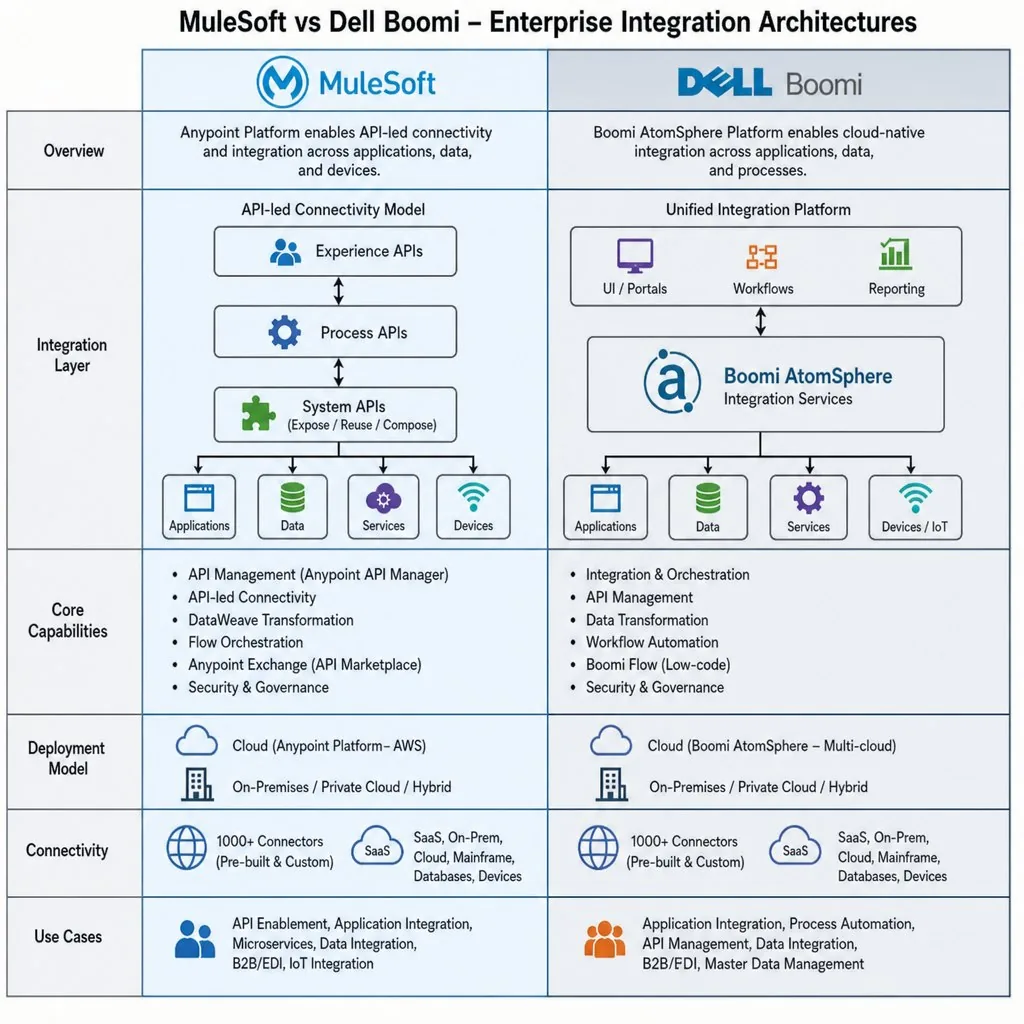
Integration Platform as a Service (iPaaS): Leading cloud integration services offer highly scalable solutions for complex, multi-layered enterprise environments. A frequent and critical debate among IT leaders is mulesoft vs dell boomi for salesforce. MuleSoft offers unparalleled native connectivity and excels at managing complex API lifecycles for massive global enterprises. Dell Boomi, conversely, is highly regarded for its intuitive drag-and-drop interface and rapid deployment capabilities, making it highly favored by mid-market companies seeking powerful connectivity without a steep learning curve.
Pre-built Connectors: For somewhat simpler business needs, pre-built salesforce connectors provide convenient, plug-and-play functionality. These connectors seamlessly link widely used software—such as Mailchimp, Slack, Jira, or QuickBooks—without requiring your in-house team to write extensive lines of custom code.
Understanding the Technical Integration Approaches
To build a truly scalable technical architecture, it is essential to understand the underlying mechanics of how your data securely moves from point A to point B.
API Integrations: At the very core of almost all modern system connections is salesforce api integration. Depending on the complexity, data payload size, and security requirements of your platforms, developers must choose between rest and soap api integration methods. REST is lightweight, incredibly flexible, and very easy to read, making it ideal for modern web and mobile applications. SOAP is highly structured, strictly standardized, and exceptionally secure, making it the preferred method for dealing with strict enterprise-level financial systems or older legacy architectures.
Custom Code Solutions: Sometimes standard middleware and off-the-shelf APIs fall short of accommodating highly unique, complex business logic. In these specific scenarios, businesses frequently turn to specialized custom apex development services. Apex is Salesforce’s proprietary programming language, allowing developers to build tailored triggers and complex classes that govern exactly how and when custom data is processed.
External Databases: If your company relies heavily on massive data warehouses, connecting salesforce to external databases (such as Amazon Web Services, Oracle, or Microsoft SQL Server) is an absolute necessity. This architectural approach offloads heavy data storage away from Salesforce, which significantly reduces platform costs while keeping vital reporting metrics readily accessible.
High-Impact Integration Use Cases
What does a successful, comprehensive system integration look like in daily practice? Here are a few transformative examples of how connected systems drive business value:
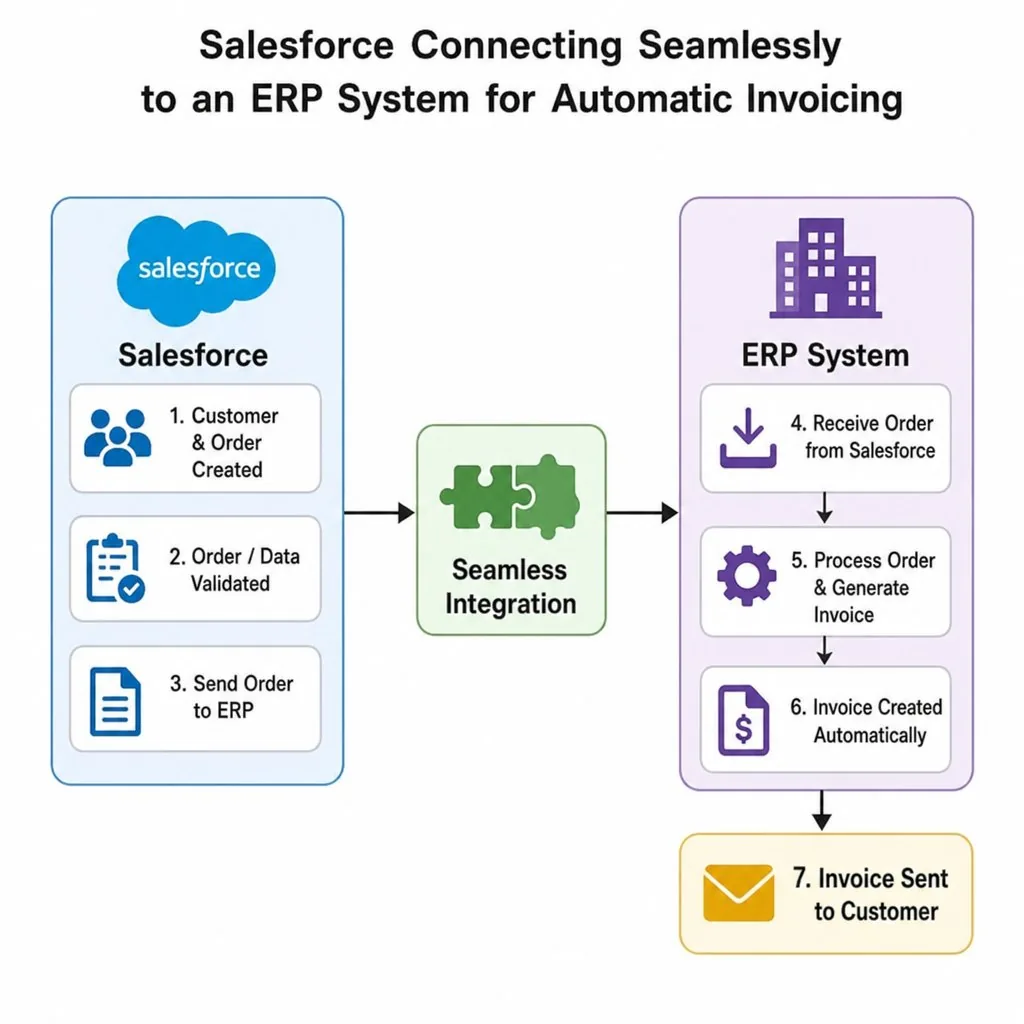
ERP Alignment: Securely connecting salesforce to enterprise resource planning (ERP) systems—like SAP, Microsoft Dynamics, or Oracle NetSuite—is a massive operational game-changer. It cleanly bridges the divide between front-office sales and back-office fulfillment. When a high-value deal is closed in Salesforce, an invoice is automatically generated in the accounting system, and the necessary physical inventory is instantly allocated in the warehouse.
Workflow Automation: Following the correct steps to automate salesforce workflows can easily save your staff hundreds of tedious administrative hours every month. For instance, successfully integrating a digital document signing application can trigger a fully automated status update on a lead's CRM profile the exact moment a contract is legally signed.
Service Delivery Integration: For consulting firms and service providers, seamlessly integrating salesforce professional services automation software (PSA), such as FinancialForce, helps leadership easily manage project delivery. It enables managers to track employee billable hours, monitor project profitability, and accurately forecast resource utilization directly from within the familiar Salesforce ecosystem.
Finding the Right Implementation Partner
Even if you license the absolute best integration tools on the market, successful execution is everything. Attempting a massive, complex integration completely in-house without deep specialized knowledge can quickly lead to painful budget overruns, delayed timelines, and fragile, broken systems. That is precisely why leaning on dedicated salesforce integration experts is a vital step for most growing businesses.
But how to choose a salesforce implementation partner that perfectly fits your specific organizational needs? Consider evaluating these critical factors:
Look for Official Certifications: You should always prioritize salesforce appexchange certified partners. These professional consulting agencies have been rigorously vetted by Salesforce directly and possess proven, publicly documented track records of technical success.
Relevant Industry Experience: The top-rated salesforce consulting firms do not just understand software functionality; they deeply understand your specific industry sector. An agency highly experienced in strict healthcare compliance will naturally approach an integration project very differently than an agency focused on fast-paced retail e-commerce.
Comprehensive Service Offerings: Seek out highly capable salesforce integration partners who offer holistic salesforce integration solutions. The best implementation partners provide end-to-end services, moving from initial strategic roadmapping and architecture design, all the way through to deployment, post-launch user support, and vital employee training.
Cost Structures and Partner Engagement Models
Properly budgeting for these large-scale technical initiatives requires extremely careful consideration and advanced planning. The overall cost of salesforce integration projects varies wildly based on numerous interconnected factors, including the total number of connected systems, the sheer volume of data being migrated, and the required level of custom coding. A relatively simple standard connector setup might only cost a few thousand dollars, whereas a massive, enterprise-wide custom architecture implementation could easily scale well into the six-figure range.
When engaging a professional agency for your CRM connectivity needs, you will typically need to choose between two primary operational models: managed services vs project-based integration.
Project-Based Integration: This traditional engagement model is best suited for clear, finite goals with a strict, well-defined timeline (for example, migrating from a legacy email marketing platform over to Salesforce). You pay for a specific agreed-upon deliverable by a specific date.
Managed Services: This ongoing business model is highly ideal for continuous technical support, regular system software updates, and persistent optimization as your business operations scale upward over time. A managed services model provides excellent peace of mind, knowing that your critical system integrations are being actively monitored, patched, and meticulously maintained by a dedicated team of certified experts every single day.
Best Practices for a Smooth Integration Journey
Before embarking on your CRM integration journey, carefully consider implementing these highly proven best practices to guarantee ultimate project success:
Clean Your Data First: You should never migrate messy or outdated data. Always cleanly deduplicate your existing records to ensure your newly integrated system starts with a pristine database.
Define Clear Business Objectives: Thoroughly outline exactly what business outcomes you expect to achieve. Are you trying to reduce customer wait times, or speed up the monthly billing cycle? Let these clear goals drive your technical architectural choices.
Test Extensively Before Launch: Always thoroughly utilize dedicated Salesforce Sandboxes to rigorously test new integrations and complex workflows before ever pushing them out to your live production environment.
Conclusion
Creating a beautifully synchronized, highly connected digital ecosystem is the ultimate key to unlocking unparalleled long-term business growth, vital internal efficiency, and significantly elevated customer satisfaction. By intelligently leveraging the right modern software tools, consistently employing careful technical design strategies, and diligently partnering with seasoned, certified industry experts, you can dramatically transform your baseline CRM setup. Rather than merely existing as a standalone application, a thoroughly and expertly integrated Salesforce environment quickly becomes the highly intelligent, indispensable central nervous system of your entire global business operations.