NPSP Migration Decisions · MD-1
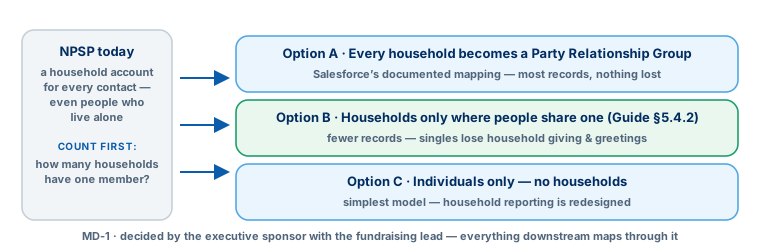
How will households be represented in Agentforce Nonprofit?
NPSP keeps each household as an Account; Agentforce Nonprofit (aka Nonprofit Cloud) keeps people as Person Accounts[2] grouped into household Party Relationship Groups. Every donor, gift rollup and relationship is mapped through this choice — which is why it comes right after the target-org decision, and before gift classification.[3]
Who decides
Executive sponsor with the fundraising lead
Decide after
AD-1 (target org strategy)
Estimated effort
L count first, then align the stakeholders
What answers it
The NPSP account model in use (the Household Account record type on Account), and — with counts-only profiling — how many households have one member or none.
Your options, and what each one does
The Options| The option | What it means for the migration |
|---|---|
| Households become Party Relationship Groups | Salesforce’s documented mapping: each household stays a business account, marked as a household by its Party Relationship Group; its people join through account–contact relationships, and a household gift’s hard credit moves to its primary contact. |
| Households only where people share one | The recommendation of Salesforce’s  Migration Guide v2.0[1] (§5.4.2): only households with more than one member are kept; a one-member household’s person stays a Person Account without a household — fewer records, but no household-level giving or greeting for them. |
| Individuals only — no households | Every person stands alone; household giving, greetings and addresses move to the people, and household reporting is redesigned. |
What Horus Eye recommends — and when
Recommendation, Not VerdictKeeping households only where people actually share one, when the org uses NPSP’s Household Account model — because NPSP creates a household account for every contact, so this option can remove a large share of account records. The trade-off: a one-person household loses household-level giving and greetings. Count your one-member households before you choose.
A recommendation is a starting point, not a verdict. The same question lands differently org by org — one fact about your automation, volumes or vendors can flip the right answer. That is why the reasons are stated, and what would change them.
How this decision plays out
In PracticeThe reason this decision ripples so far: NPSP creates a household account for every contact, including people who live alone. In a typical NPSP org a large share of households have exactly one member, so the middle option — keep households only where people actually share one — can remove a surprising fraction of your account records, which is why it is the Migration Guide’s own recommendation. The price is specific and worth saying to your fundraising lead out loud: a one-person household loses household-level giving history, household greetings and the household address record, because that person now stands alone as a Person Account. If your acknowledgement letters, year-end receipts or major-gift reports are written at the household level for everyone, the model you choose changes what those documents say. Choosing “individuals only” goes further still: household reporting is not migrated but redesigned, which is honest work — just budget for it.
Whichever way you lean, count before you choose. The number of one-member households, the number of households with shared giving, and the reports that aggregate at household level are all measurable in NPSP today — and they turn this from a philosophical debate into an arithmetic one.
Questions to settle before you record an answer
Before You Decide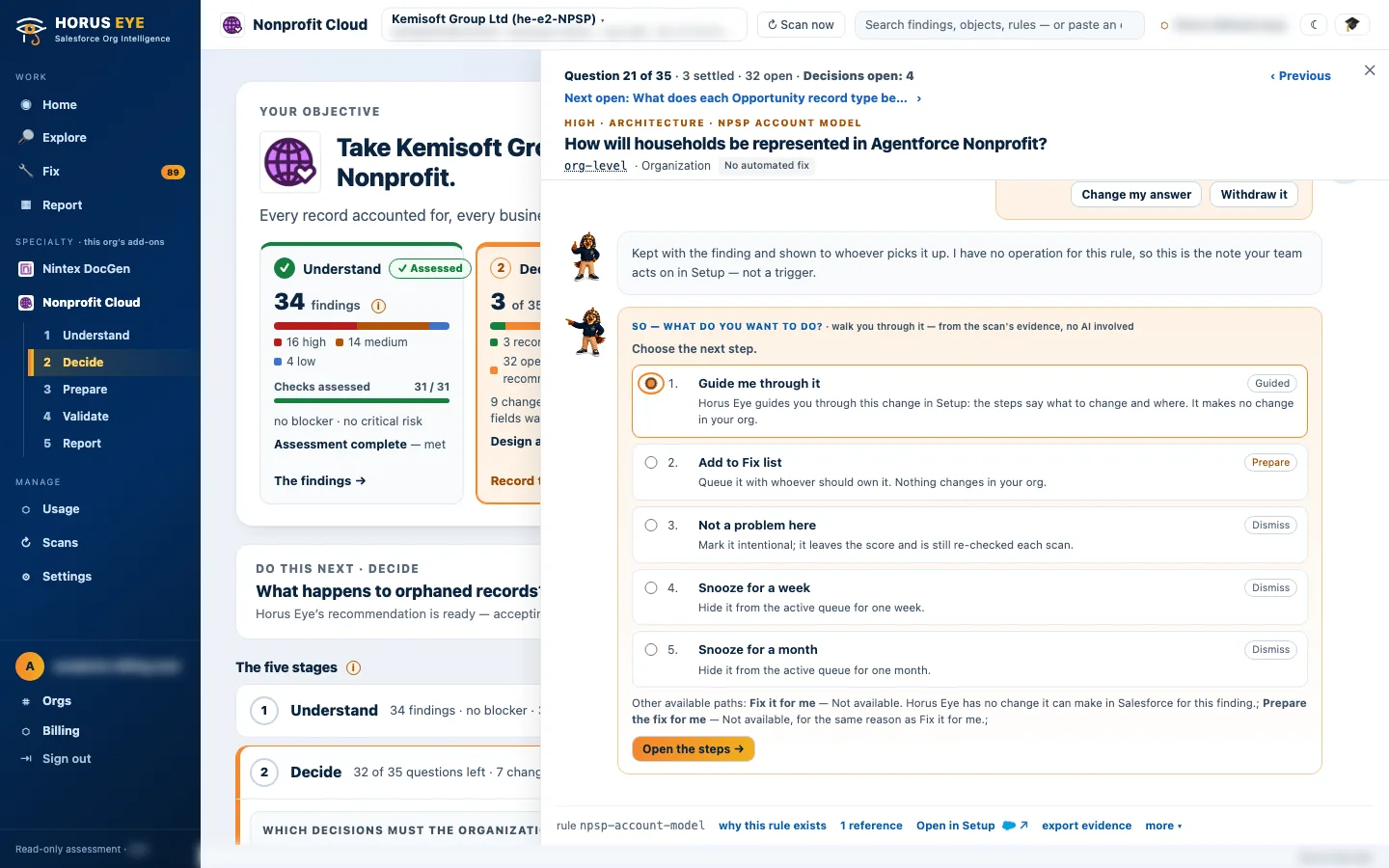
How Horus Eye helps
With Horus EyeWhen Horus Eye assesses an NPSP org, this question is raised with the evidence the scan saw — the record types, fields and settings behind it — its recommendation marked, and the reasons stated. Accept records the recommendation; Change opens the options. Recording an answer writes nothing to Salesforce: it is captured in the decision register, with who decided and when, and the migration plan, mappings and documents are kept consistent with what your organization actually decided. Horus Eye recommends; your organization decides.
Related decisions
Keep Planning- AD-9 · Household soft credits — Do household members’ automatic contact roles become Gift Soft Credits?
- MD-2 · Gift classification — What does each Opportunity record type become: Gift Transaction, Gift Commitment, or Opportunity?
- AD-1 · Target org strategy — A new Agentforce Nonprofit org, or transform NPSP in place?
- AD-7 · Duplicates during the load — Do duplicate and matching rules run while the migration loads?
- All sixteen decisions →
Sources & further reading
References- 1. Salesforce · Agentforce Nonprofit Migration Guide v2.0 (PDF) — The official guide this content follows: platform differences, migration recommendations, and how NPSP features map to Agentforce Nonprofit. ↩︎
- 2. Salesforce Help · Enable Person Accounts for Fundraising — The enablement step — and why it is planned, not casual: Person Accounts cannot be disabled once enabled. ↩︎
- 3. Salesforce Help · Nonprofit Cloud Data Model Objects — The target objects, as Salesforce documents them. ↩︎
“Salesforce”, “Agentforce” and related marks are the property of Salesforce, Inc. Horus Eye is an independent product and is not affiliated with, endorsed, or sponsored by Salesforce, Inc.
Protected AI — the Trust Layer
Every AI read in Horus Eye is metadata-first: built from an allowlist, sanitized by pattern, made through one audited gateway and checked by an output firewall on the way back — and AI is off by default, per org. Every request carries an audit id and an AI Data Scope manifest you can open.
Facing this decision in your own org?
Horus EyeA read-only assessment puts the evidence behind it on the table — what your org holds, what it means for this choice, and the decisions that depend on it.
Try Horus Eye Free Request an Assessment All Horus Eye pagesFree start · 250 credits for 60 days · no card required · scans are free