NPSP Migration Decisions · MD-7
Which Program Management data must migrate to the target program and benefit objects?
A Program Management[1] Module migration maps PMM objects — programs, enrollments, benefits, service deliveries, outcomes — to several Agentforce Nonprofit objects. Which ones matter depends on whether they hold data the organization still needs. This decision applies only when PMM is installed; programs kept on an org’s own custom objects are a separate conversation.
Who decides
Program lead
Decide after
No prerequisite — decide in parallel
Estimated effort
M scope by record counts, with the program team
What answers it
Program Management objects in the org (and, with counts-only profiling, how many records each holds).
Your options, and what each one does
The Options| The option | What it means for the migration |
|---|---|
| Migrate the program objects that hold data | Each mapped object with records is planned; empty ones are not. |
| Archive program history | History is kept outside the live model — readable, retained, but not loaded. |
What Horus Eye recommends — and when
Recommendation, Not VerdictLet the record counts drive the scope: migrate what the program team still works with, archive what they only look back at. The program lead owns this one, because only they know which histories still matter to funders and auditors. A program management module migration stands or falls on this inventory.
A recommendation is a starting point, not a verdict. The same question lands differently org by org — one fact about your automation, volumes or vendors can flip the right answer. That is why the reasons are stated, and what would change them.
How this decision plays out
In PracticeProgram data has a different audience than fundraising data, which is why this decision has its own owner. Donors and gifts answer to the fundraising team and finance; programs, enrollments, service deliveries and outcomes answer to program staff, funders and — in many organizations — grant compliance. A funder who required five years of outcome reporting does not care that the CRM changed underneath it. So the scope question is not “can this data move?” (Salesforce maps the Program Management Module’s objects to their Agentforce Nonprofit counterparts) but “which of it does anyone still need live?”
Record counts make the conversation concrete: objects that hold data get a plan, empty ones do not, and history that is kept for compliance rather than daily work can live in a verified-readable archive instead of the live org. One boundary worth stating plainly to stakeholders: programs built on an org’s own custom objects — rather than the Program Management Module — are outside Salesforce’s mapping[2] and outside this decision; they need their own design conversation, and pretending otherwise just defers the surprise.
Questions to settle before you record an answer
Before You Decide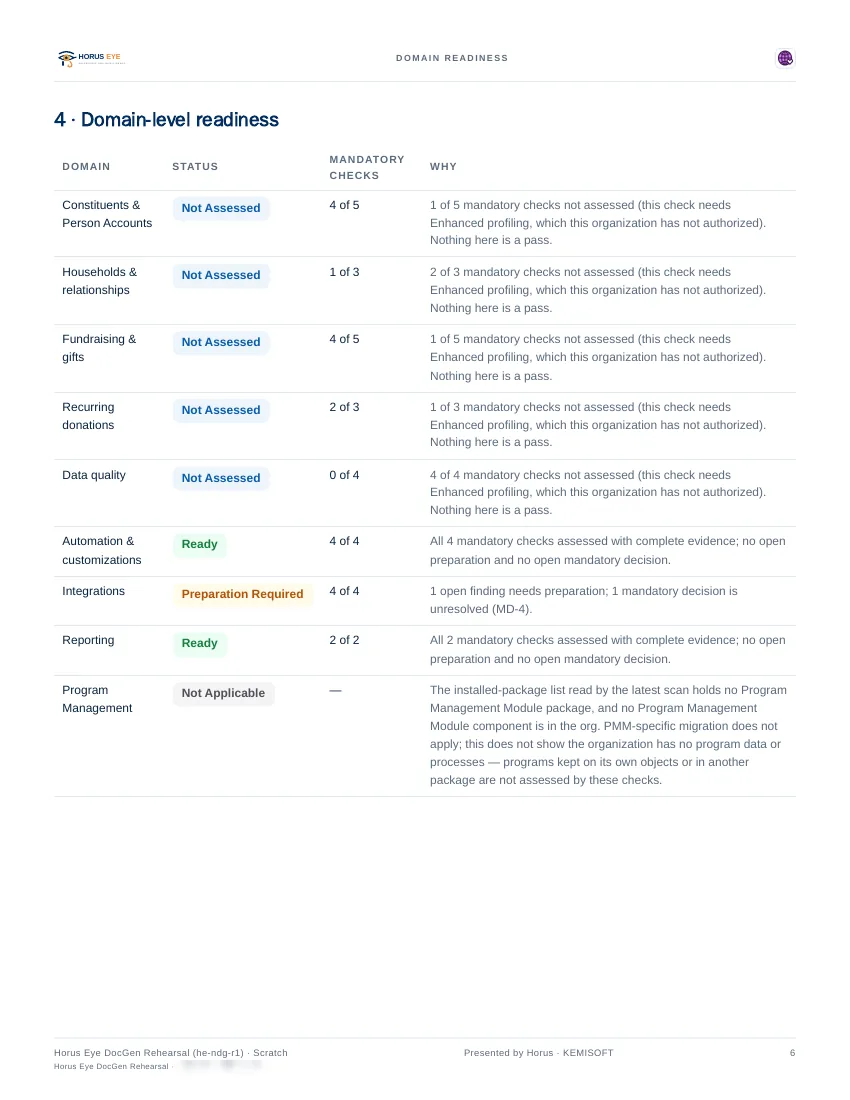
How Horus Eye helps
With Horus EyeWhen Horus Eye assesses an NPSP org, this question is raised with the evidence the scan saw — the record types, fields and settings behind it — its recommendation marked, and the reasons stated. Accept records the recommendation; Change opens the options. Recording an answer writes nothing to Salesforce: it is captured in the decision register, with who decided and when, and the migration plan, mappings and documents are kept consistent with what your organization actually decided. Horus Eye recommends; your organization decides.
Related decisions
Keep PlanningSources & further reading
References- 1.
 Salesforce · Program Management Implementation Guide (PDF) — Implementation strategies for Agentforce Nonprofit Program Management. ↩︎
- 2. Salesforce · Agentforce Nonprofit Migration Guide v2.0 (PDF) — The official guide this content follows: platform differences, migration recommendations, and how NPSP features map to Agentforce Nonprofit. ↩︎
“Salesforce”, “Agentforce” and related marks are the property of Salesforce, Inc. Horus Eye is an independent product and is not affiliated with, endorsed, or sponsored by Salesforce, Inc.
Protected AI — the Trust Layer
Every AI read in Horus Eye is metadata-first: built from an allowlist, sanitized by pattern, made through one audited gateway and checked by an output firewall on the way back — and AI is off by default, per org. Every request carries an audit id and an AI Data Scope manifest you can open.
Facing this decision in your own org?
Horus EyeA read-only assessment puts the evidence behind it on the table — what your org holds, what it means for this choice, and the decisions that depend on it.
Try Horus Eye Free Request an Assessment All Horus Eye pagesFree start · 250 credits for 60 days · no card required · scans are free