NPSP Migration Decisions · MD-2
What does each Opportunity record type become: Gift Transaction, Gift Commitment, or Opportunity?
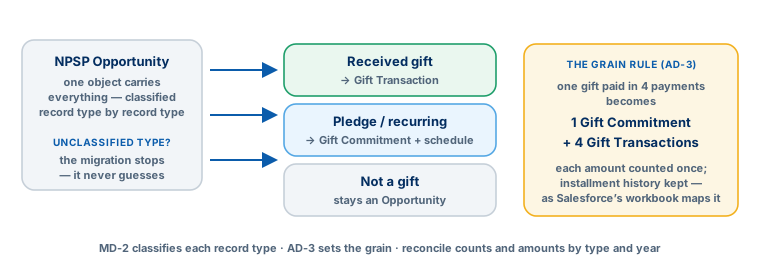
The NPSP opportunity record types question is where Agentforce Nonprofit splits what NPSP keeps on Opportunity into gift objects: a received gift becomes a Gift Transaction[2], a pledge or recurring gift a Gift Commitment[3], and a real sales-style opportunity stays an Opportunity. The classification decides how every historical and open gift of that type is migrated and reported — and you also decide what a closed-lost gift becomes.[1]
Who decides
Fundraising lead with finance
Decide after
MD-1 (household model)
Estimated effort
M one working session per record type, with finance
What answers it
The org’s Opportunity record types (and, with counts-only profiling, how many closed, open and won gifts each holds).
Your options, and what each one does
The Options| The option | What it means for the migration |
|---|---|
| Classify each record type | Each type maps to its own target; received gifts become Gift Transactions, pledges and recurring become Gift Commitments, non-gifts stay Opportunities. A proposed starting classification is offered where the evidence supports one. |
| Keep every record type on Opportunity | No gift objects are used for these types; gift-specific features of the target — commitments, designations, soft credits, fundraising rollups — do not apply to them. |
What Horus Eye recommends — and when
Recommendation, Not VerdictClassifying each record type, because the gift objects are where Agentforce Nonprofit’s fundraising features live. The migration does not guess: a record type left unclassified stops the gift migration until someone answers — which is the safe behaviour, not a defect. Classifying NPSP opportunity record types early keeps every later mapping decision consistent.
A recommendation is a starting point, not a verdict. The same question lands differently org by org — one fact about your automation, volumes or vendors can flip the right answer. That is why the reasons are stated, and what would change them.
How this decision plays out
In PracticeRecord types are where orgs quietly disagree with themselves. In one org “Grant” is a received gift; in another it is a multi-year commitment paid in installments; in a third it is a pipeline opportunity that may never close. The same label, three different migration answers — which is why this classification cannot be templated and why a responsible migration stops rather than guesses when a record type has no recorded answer. Getting it wrong produces the two classic post-migration complaints: giving history that is counted twice (a pledge and its payments both treated as received gifts), and revenue reports that no longer match the old org’s, because records changed category on the way across.
Two sub-questions ride along. First, closed-lost gifts: they are not revenue, but they are history — decide whether they stay as Opportunities or are excluded, and write it down. Second, the stage, payment-method and acknowledgement values your record types carry: any value the target does not have needs a mapped destination, and an unmapped value should surface as an exception rather than default silently. Reconcile the result the only way that settles arguments: gift counts and amounts by record type and fiscal year, old org against new, before anyone calls it done.
Questions to settle before you record an answer
Before You DecideHow Horus Eye helps
With Horus EyeWhen Horus Eye assesses an NPSP org, this question is raised with the evidence the scan saw — the record types, fields and settings behind it — its recommendation marked, and the reasons stated. Accept records the recommendation; Change opens the options. Recording an answer writes nothing to Salesforce: it is captured in the decision register, with who decided and when, and the migration plan, mappings and documents are kept consistent with what your organization actually decided. Horus Eye recommends; your organization decides.
Related decisions
Keep Planning- AD-3 · Gift record grain — Which source record becomes the Gift Transaction: the gift, its payment, or both?
- MD-3 · Recurring collection — How are recurring donations collected today, and how will their schedules continue after migration?
- MD-6 · Historical totals — Which historical totals and reports must survive the migration — and how will they be produced?
- AD-6 · Campaign attribution — Outreach Source Codes under the campaigns, or campaigns alone?
- All sixteen decisions →
Sources & further reading
References- 1.
 Salesforce · Agentforce Nonprofit Migration Guide v2.0 (PDF) — The official guide this content follows: platform differences, migration recommendations, and how NPSP features map to Agentforce Nonprofit. ↩︎
- 2. Salesforce Help · Gift Transactions — The received-gift object NPSP Opportunities classify into. ↩︎
- 3. Salesforce Help · Gift Commitments — How recurring giving and pledges live in the target. ↩︎
“Salesforce”, “Agentforce” and related marks are the property of Salesforce, Inc. Horus Eye is an independent product and is not affiliated with, endorsed, or sponsored by Salesforce, Inc.
Protected AI — the Trust Layer
Every AI read in Horus Eye is metadata-first: built from an allowlist, sanitized by pattern, made through one audited gateway and checked by an output firewall on the way back — and AI is off by default, per org. Every request carries an audit id and an AI Data Scope manifest you can open.
Facing this decision in your own org?
Horus EyeA read-only assessment puts the evidence behind it on the table — what your org holds, what it means for this choice, and the decisions that depend on it.
Try Horus Eye Free Request an Assessment All Horus Eye pagesFree start · 250 credits for 60 days · no card required · scans are free